
FNPS Plant Database
Avicennia germinans
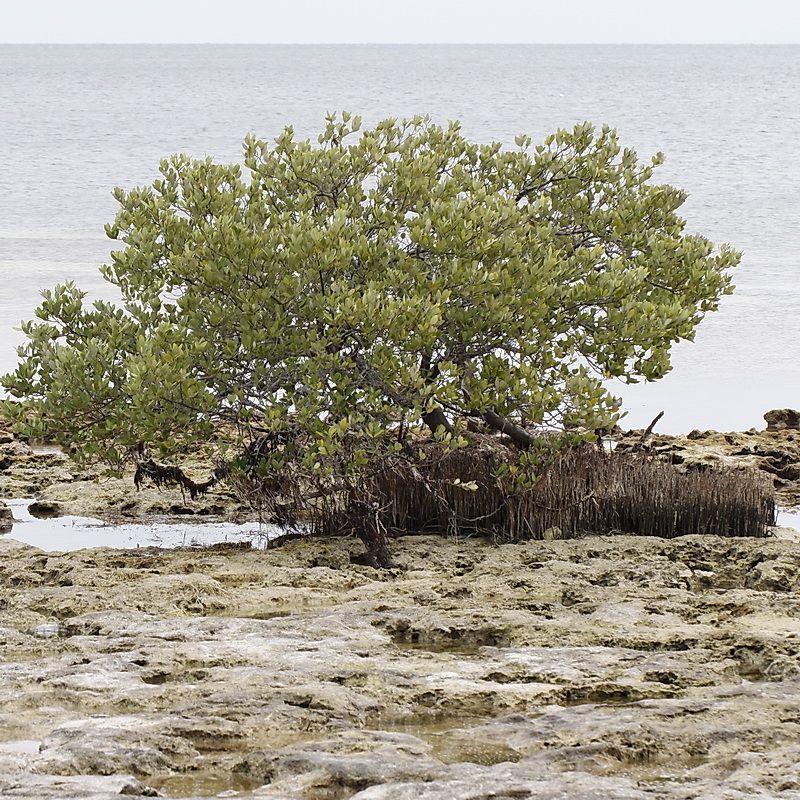
Photographs belong to the photographers who allow use for FNPS purposes only. Please contact the photographer for all other uses.
Nomenclature
Common Name:
Synonym(s):
Genus species:
Avicennia germinans
Family:
Avicenniaceae
Plant Specifics
Form:
Size:
15-40 (60) ft tall by 10-30 ft wide
Life Span:
Flower Color:
Fruit Color:
Phenology:
Evergreen. Sends up pheumatophores. Seeds germinate on the tree.
Noted For:
Landscaping
Recommended Uses:
Considerations:
Availability:
Propagation:
Light:
Moisture Tolerance:
Always Flooded------------------------------------------------Extremely Dry
-|- ---
<---------> ----|----|----|----|----|----|----|----|----
Stays Wet ---to--- Stays Wet
Salt Water Flooding Tolerance:
High. Can tolerate significant and ongoing amounts of salty wind and salt spray without injury.
Salt Spray/Salty Soil Tolerance:
Tolerant of frequent or regular inundation (usually areas with tidal inundation)
Soil or Other Substrate:
Sand, Marine Alluvium
Soil pH:
Suitable to Grow In:
9A, 9B, 10A, 10B, 11

USDA zones are based on the average annual extreme minimum winter temperature.
Don't know your zone? Click here to search by zip code.
Ecology
Wildlife:
Larval host for mangrove buckeye (Junonia genoveva) butterfly. Nectar plant for a variety of pollinators including the great southern white (Ascia monuste) butterfly. Nectar used by butterflies. Pollinated by bees, wasps, and flies. (Landry, 2013).
Native Habitats:
Coastal mangrove wetlands, usually somewhat upland of the red mangrove (Rhizophora mangle) when found together.
Natural Range in Florida:
Visit the USF Libraries Atlas of Florida Plants
Comments:
Ethnobotany:
General Comments:
The common name black mangrove is a reference to the color of the trunk and heartwood. The plant excretes salt from its leaves, an adaptation to a saline environment. Pneumatophores rise above the substrate and make this an important plant for coastline erosion prevention. This is a protected plant and you may not trim back or gather propagules without permission.



Citations:
Landry, Carol L. Pollinator-mediated competition between two co-flowering Neotropical mangrove species, Avicennia germinans (Avicenniaceae) and Laguncularia racemosa (Combretaceae). Annals of Botany. 2013 Feb;111(2):207-14. https://doi.org/10.1093/aob/mcs265 , accessed 2025.
Haehle, Robert G. and Joan Brookwell. 1999. Native Florida Plants. Gulf Publishing Company. Houston, TX.
Gann, G.D., C.J. Abbott, C.G. Stocking, K.N. Hines, and collaborators. Natives For Your Neighborhood. https://www.regionalconservation.org/beta/nfyn/plantdetail.asp?tx=Avecgerm , accessed 2025. The Institute for Regional Conservation. Delray Beach, Florida.
Nelson, Gil. 2003. Florida's Best Landscape Plants: 200 Readily Available Species for Homeowners and Professionals. University Press of Florida, Gainesville.
Workman, Richard W. 1980. Growing Native: Native Plants for Landscape Use in Coastal South Florida. Sanibel-Captiva Conservation Foundation, Inc.: Sanibel, FL.
Wunderlin, R. P., B. F. Hansen, A. R. Franck, and F. B. Essig. 2021. Atlas of Florida Plants. https://florida.plantatlas.usf.edu/ , accessed 2025. Institute for Systematic Botany, University of South Florida, Tampa.

