


Comunidades de plantas nativas de Florida
Euphoric Lake
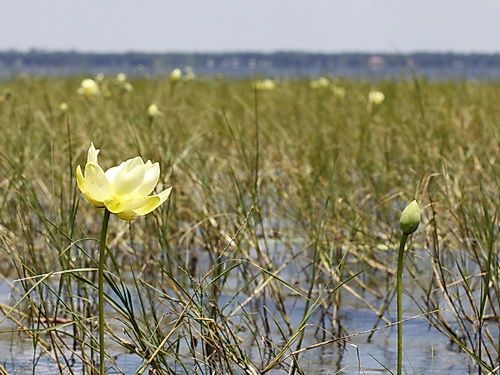
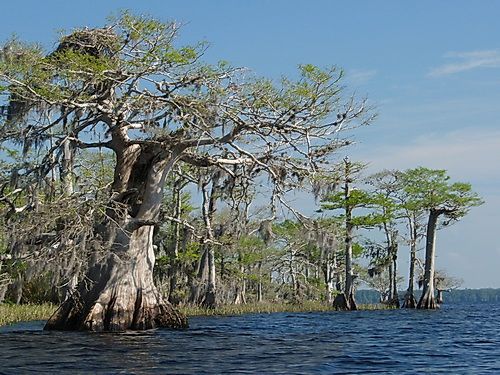
Las fotografías pertenecen a los fotógrafos que permiten su uso únicamente para fines de FNPS.
Información
Variantes de la comunidad:
Floodplain Lakes
Descripción:
Eutrophic lakes typically have major inflows and outflows, and their water and vegetation reflect high nutrient content. These lakes often accumulate deep peats and typically support broad vegetated shore zones. Most are considered nutrient-rich (eutrophic).
Vegetation
In shallow areas, vegetation tends to be dense, with emergent species such as cattails ( Typha spp. ) being common. Given the generally murky water, emergent vegetation dominates, while submersed vegetation is rare in deeper areas. Invasive aquatic plants are strongly associated with these lakes (Hoyer et al., 1996). Cypress fringes are also common along lake margins.
Human Impacts
Most eutrophic lakes in Florida have been significantly altered by humans—both in terms of hydrology and nutrient loading from input streams and upland runoff. A study of Little Lake Jackson in south-central Florida (Whitmore et al., 2006) illustrates such changes. Since 1890, land-use practices—including golf course and residential lawn management (liming and irrigation with alkaline well water), stormwater runoff, and septic leaching—have caused the lake to shift from acidic to alkaline, with greatly increased nutrient levels. These changes also likely altered water clarity and vegetation structure.
Ecological Importance
Despite water quality issues, eutrophic lakes support distinct plant communities and provide important habitat for birds, fish, insects, and water for surrounding upland animals. Compared to clear lakes, emergent vegetation here is restricted to very shallow areas, since light penetration is too low to sustain extensive submersed or floating-leaved vegetation.
Example Locations
- Lake Thonotosassa (Hillsborough County)
- Lake Okeechobee
- Lake Istokpoga (Highlands County)
- Most lakes along the St. Johns River
Floodplain Lakes
Floodplain lakes occur along major river systems, with the river itself serving as their primary water source. Nearly all are eutrophic, reflecting the nutrient-rich water quality of their associated streams.
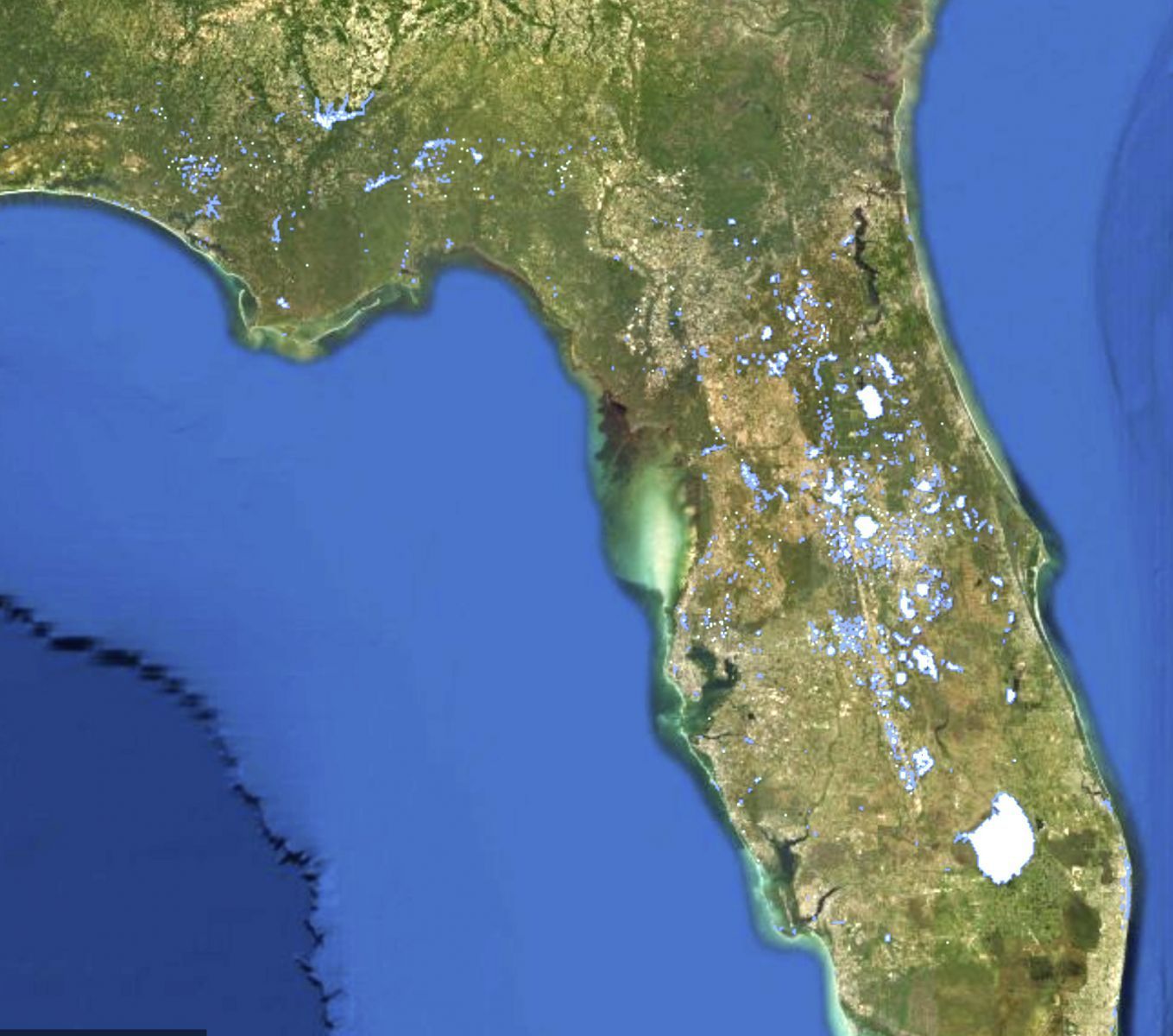
Map of Florida Lakes, from Florida Lake Watch website with the map restricted to showing lakes and ponds only. This map does not classify lakes by pH or trophic state.
Referencias:
Florida Natural Areas Inventory. (2010). Guide to the natural communities of Florida: 2010 edition. Florida Natural Areas Inventory. http://fnai.org/naturalcommguide.cfm
Hoyer, M., Canfield, D. E., Jr., Horsburgh, C. A., & Brown, K. (1996). Florida freshwater plants: A handbook of common aquatic plants in Florida lakes. University of Florida, Institute of Food and Agricultural Sciences.
Schiffer, D. M. (1998). Hydrology of central Florida lakes: A primer (U.S. Geological Survey Circular 1137). U.S. Geological Survey. http://fl.water.usgs.gov/PDF_files/c1137_schiffer.pdf
University of South Florida Water Institute. (2020). Florida atlas of lakes. https://maps.wateratlas.usf.edu/AtlasOfLakes/
Whitmore, T. J., Brenner, M., Kolasa, K. V., Kenney, W. F., Riedinger-Whitmore, M. A., Curtis, J. H., & Smoak, J. M. (2006). Inadvertent alkalization of a Florida lake caused by increased ionic and nutrient loading to its watershed. Journal of Paleolimnology, 36(4), 353–370. https://doi.org/10.1007/s10933-006-9000-0
Whitney, E. N., Means, D. B., & Rudloe, A. (2004). Priceless Florida: Natural ecosystems and native species. Pineapple Press.
Haga clic para obtener más información sobre las diferentes comunidades de plantas de Florida o desplácese por la página para ver toda la maravillosa diversidad única que se puede explorar.
Tierras altas xéricas (muy secas)
Tierras altas algo secas
Tierras altas húmedas
Tierras rocosas
llanuras húmedas
Humedales de la cuenca
Humedales de filtración
Humedales con aguas de movimiento lento
Humedales de llanura aluvial
Arroyos
Lagos y estanques
Tierras altas costeras
Humedales costeros

