


Comunidades de plantas nativas de Florida
Floodplain Forest
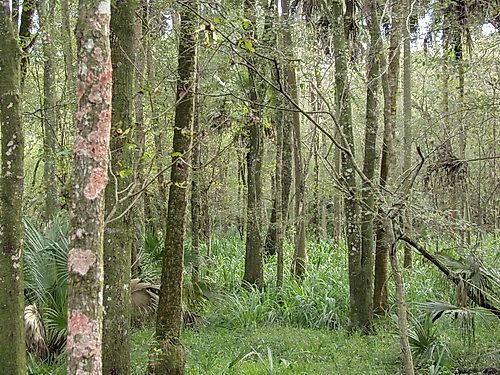
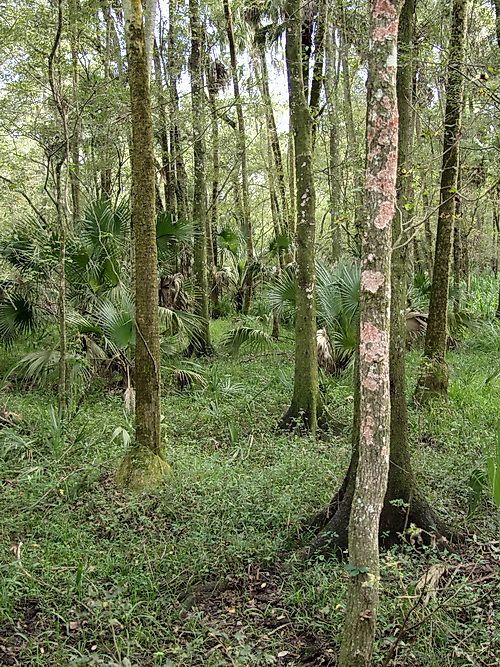
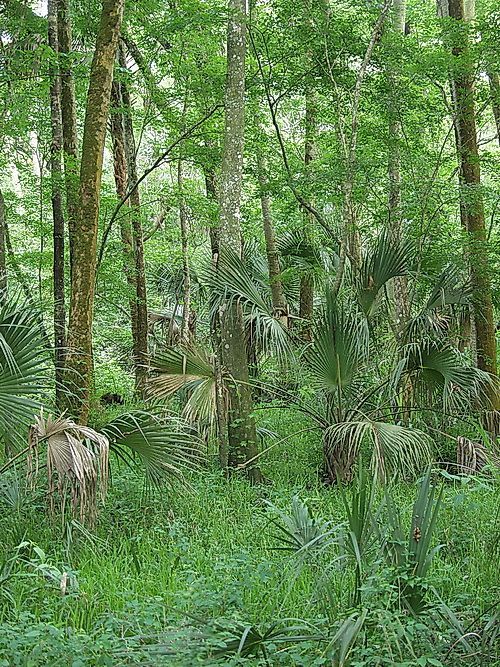
Las fotografías pertenecen a los fotógrafos que permiten su uso únicamente para fines de FNPS.
Información
Variantes de la comunidad:
N/A
Descripción:
Floodplain forests are seasonally inundated, closed-canopy forests that vary in substrate and hydrology depending on local topography and geology. Many, though not all, occur on alluvial soils (sand, silt, clay). These are short-hydroperiod forests, typically flooding only when streams rise out of their banks. They may or may not qualify as jurisdictional wetlands. Fire is rare.
Vegetation
Canopy composition varies with climate and hydrology but commonly includes sweetgum ( Liquidambar styraciflua ), loblolly pine ( Pinus taeda ), sweetbay magnolia ( Magnolia virginiana ), swamp laurel oak ( Quercus laurifolia ), water oak ( Quercus nigra ), live oak ( Quercus virginiana ), swamp chestnut oak ( Quercus michauxii ), sugarberry ( Celtis laevigata ), American elm ( Ulmus americana ), and red maple ( Acer rubrum ).
The understory may include American hornbeam ( Carpinus caroliniana ), swamp dogwood ( Cornus foemina ), possumhaw ( Ilex decidua ), dwarf palmetto ( Sabal minor ), wax myrtle ( Morella cerifera ), and highbush blueberry ( Vaccinium corymbosum ). Groundcover is variable, often including panic grasses ( Panicum spp. ), witchgrasses ( Dichanthelium spp. ), slender woodoats ( Chasmanthium laxum ), and beaksedges and sedges ( Rhynchospora and Carex spp.). (Modified from FNAI, 2010.)
Example Locations
Floodplain forests occur along many river systems throughout both the Florida peninsula and the Panhandle.
Referencias:
Clewell, A. F. (1986). Natural setting and vegetation of the Florida Panhandle: An account of the environments and plant communities of northern Florida west of the Suwannee River (Report No. COESAM/PDEI-86/001). U.S. Army Corps of Engineers, Mobile District.
Duever, L. (1984, September). Florida’s natural communities: Floodplains. The Palmetto, 4(3), 8–10. http://fnps.org/assets/pdf/palmetto/duever_linda_conway_natural_communities_of_floridas_floodplains_vol_4_no_3_fall_1984.pdf
Florida Department of Environmental Protection. (1992). Soil and water relationships of Florida's ecological communities. http://www.dep.state.fl.us/water/wetlands/delineation/docs/soil-and-water.pdf
Florida Natural Areas Inventory. (2010). Guide to the natural communities of Florida: 2010 edition. Florida Natural Areas Inventory. http://fnai.org/naturalcommguide.cfm
Florida Natural Areas Inventory, & Florida Department of Natural Resources. (1990). Guide to the natural communities of Florida. Florida Natural Areas Inventory. http://fnai.org/PDF/Natural_Communities_Guide_1990.pdf
Light, H. M., & Darst, M. R. (1993). Hydrology, vegetation, and soils of four north Florida river flood plains with an evaluation of state and federal wetland determinations (Water Resources Investigation Report 93-4033). U.S. Geological Survey.
Myers, R. L., & Ewel, J. J. (Eds.). (1990). Ecosystems of Florida. University of Central Florida Press.
Sharitz, R. R., & Mitsch, W. J. (1993). Southern floodplain forests. In W. H. Martin, S. G. Boyce, & A. C. Echternacht (Eds.), Biodiversity of the Southeastern United States: Lowland terrestrial communities (pp. 311–372). John Wiley & Sons.
U.S. Department of Agriculture, Soil Conservation Service. (198-). 26 ecological communities of Florida. http://ufdc.ufl.edu/UF00000110/00001
Whitney, E. N., Means, D. B., & Rudloe, A. (2004). Priceless Florida: Natural ecosystems and native species. Pineapple Press.
Haga clic para obtener más información sobre las diferentes comunidades de plantas de Florida o desplácese por la página para ver toda la maravillosa diversidad única que se puede explorar.
Tierras altas xéricas (muy secas)
Tierras altas algo secas
Tierras altas húmedas
Tierras rocosas
llanuras húmedas
Humedales de la cuenca
Humedales de filtración
Humedales con aguas de movimiento lento
Humedales de llanura aluvial
Arroyos
Lagos y estanques
Tierras altas costeras
Humedales costeros

