


Comunidades de plantas nativas de Florida
Floodplain Swamp
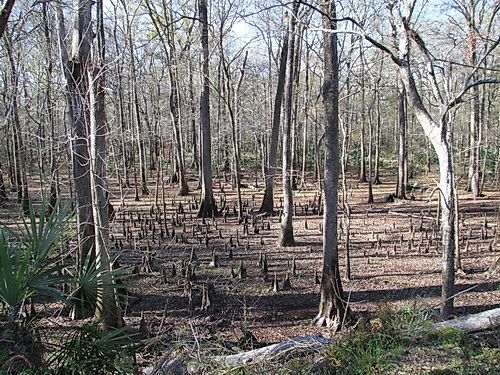
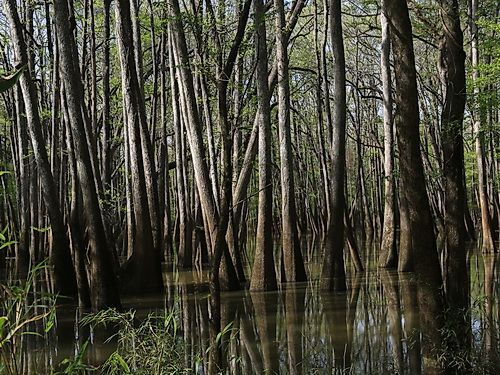
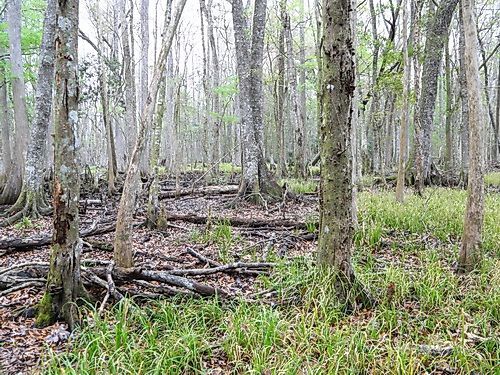
Las fotografías pertenecen a los fotógrafos que permiten su uso únicamente para fines de FNPS.
Información
Variantes de la comunidad:
N/A
Descripción:
Floodplain swamps occur on organic or alluvial substrates and are usually inundated for long periods. They are found in both subtropical and temperate settings. Fire is rare or absent.
The vegetation is typically characterized by cypress ( Taxodium spp. ), tupelo ( Nyssa aquatica ), swamp blackgum ( Nyssa sylvatica var. biflora ), and/or pop ash ( Fraxinus caroliniana ).
Example Locations
- Apalachicola River floodplain (Torreya State Park) – the best Florida example
- Choctawhatchee River floodplain
- Yellow River floodplain
- Escambia River floodplain
- Hillsborough River floodplain (peninsula)
- Manatee River floodplain (peninsula)
- Peace River floodplain (peninsula)
- Fisheating Creek floodplain (peninsula)
Referencias:
Duever, L. (1984, September). Florida’s natural communities: Floodplains. The Palmetto, 4(3), 8–10. http://fnps.org/assets/pdf/palmetto/duever_linda_conway_natural_communities_of_floridas_floodplains_vol_4_no_3_fall_1984.pdf
Florida Natural Areas Inventory, & Florida Department of Natural Resources. (1990). Guide to the natural communities of Florida. Florida Natural Areas Inventory. http://fnai.org/PDF/Natural_Communities_Guide_1990.pdf
Light, H. M., & Darst, M. R. (1993). Hydrology, vegetation, and soils of four north Florida river flood plains with an evaluation of state and federal wetland determinations (Water Resources Investigation Report 93-4033). U.S. Geological Survey.
Sharitz, R. R., & Mitsch, W. J. (1993). Southern floodplain forests. In W. H. Martin, S. G. Boyce, & A. C. Echternacht (Eds.), Biodiversity of the Southeastern United States: Lowland terrestrial communities (pp. 311–372). John Wiley & Sons.
U.S. Department of Agriculture, Soil Conservation Service. (1986). 26 ecological communities of Florida. http://ufdc.ufl.edu/UF00000110/00001
Whitney, E. N., Means, D. B., & Rudloe, A. (2004). Priceless Florida: Natural ecosystems and native species. Pineapple Press.
Haga clic para obtener más información sobre las diferentes comunidades de plantas de Florida o desplácese por la página para ver toda la maravillosa diversidad única que se puede explorar.
Tierras altas xéricas (muy secas)
Tierras altas algo secas
Tierras altas húmedas
Tierras rocosas
llanuras húmedas
Humedales de la cuenca
Humedales de filtración
Humedales con aguas de movimiento lento
Humedales de llanura aluvial
Arroyos
Lagos y estanques
Tierras altas costeras
Humedales costeros

