


Comunidades de plantas nativas de Florida
Pine Rockland
Las fotografías pertenecen a los fotógrafos que permiten su uso únicamente para fines de FNPS.
Información
Variantes de la comunidad:
N/A
Descripción:
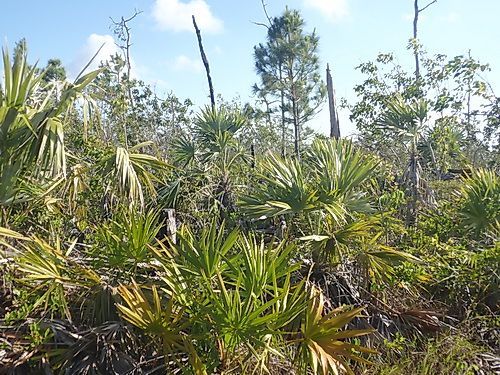
Pine rockland occurs in subtropical climate zones at elevations of 3–8 feet above mean sea level. It is characterized by an exposed limestone substrate, often with solution holes, and typically underlain by a freshwater lens ( U.S. Fish & Wildlife Service). The community ranges from mesic to xeric and is maintained by frequent fire. Other disturbances include hurricane winds and, occasionally, saltwater inundation during storm surges.
Vegetation is dominated by South Florida slash pine ( Pinus elliottii var. densa ), with palms such as thatch palm ( Thrinax radiata ) and various subtropical hardwoods. The groundcover consists of mixed grasses, herbs, and low shrubs, including pineland noseburn ( Tragia saxicola ) and Christmas berry ( Crossopetalum ilicifolium ). Pine rockland supports the highest plant diversity of any plant community in the Florida Keys, with more than 250 plant species documented (Bradley & Gann, 1999). Many of these are rare or endemic.
Excellent examples of pine rockland occur in Everglades National Park and on Big Pine Key within the National Key Deer Refuge.
Referencias:
Bradley, K., & Gann, G. (1999). The pine rockland forests of southern Florida. The Palmetto, 19(2), 12–19. http://fnps.org/assets/pdf/palmetto/bradley_keith__george_gann_the_pine_rockland_forests_of_florida_vol_19_no_2_summer_1999.pdf
Duever, L. (1984, April). Florida’s natural communities: Rocklands. The Palmetto, 4(2), 8–11. http://fnps.org/assets/pdf/palmetto/duever_linda_conway_natural_communities_of_floridas_rocklands_vol_4_no_2_april_1984.pdf
Florida Department of Environmental Protection. (1992). Soil and water relationships of Florida's ecological communities. http://www.dep.state.fl.us/water/wetlands/delineation/docs/soil-and-water.pdf
Florida Natural Areas Inventory. (2010). Guide to the natural communities of Florida: 2010 edition. Florida Natural Areas Inventory. http://fnai.org/naturalcommguide.cfm
Gann, G. D., Bradley, K. A., & Woodmansee, S. W. (2009). Floristic inventory of South Florida database. Institute for Regional Conservation. http://regionalconservation.org/ircs/database/database.asp
Knight, G. R., Oetting, J. B., & Cross, L. (2011). Atlas of Florida's natural heritage: Biodiversity, landscapes, stewardship and opportunities. Institute of Science and Public Affairs, Florida State University.
Loope, L. L., Black, D. W., Black, S., & Avery, G. N. (1979). Distribution and abundance of flora in limestone rockland pine forests of southeastern Florida. South Florida Research Center, Everglades National Park.
Myers, R. L., & Ewel, J. J. (Eds.). (1990). Ecosystems of Florida. University of Central Florida Press.
U.S. Department of Agriculture, Soil Conservation Service. (198-). 26 ecological communities of Florida. http://ufdc.ufl.edu/UF00000110/00001
Whitney, E. N., Means, D. B., & Rudloe, A. (2004). Priceless Florida: Natural ecosystems and native species. Pineapple Press.
Haga clic para obtener más información sobre las diferentes comunidades de plantas de Florida o desplácese por la página para ver toda la maravillosa diversidad única que se puede explorar.
Tierras altas xéricas (muy secas)
Tierras altas algo secas
Tierras altas húmedas
Tierras rocosas
llanuras húmedas
Humedales de la cuenca
Humedales de filtración
Humedales con aguas de movimiento lento
Humedales de llanura aluvial
Arroyos
Lagos y estanques
Tierras altas costeras
Humedales costeros

