


Comunidades de plantas nativas de Florida
Rockland Hammock
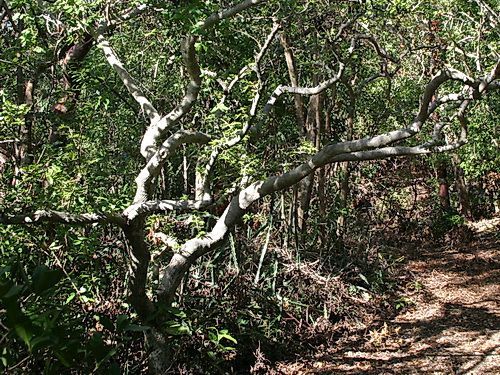
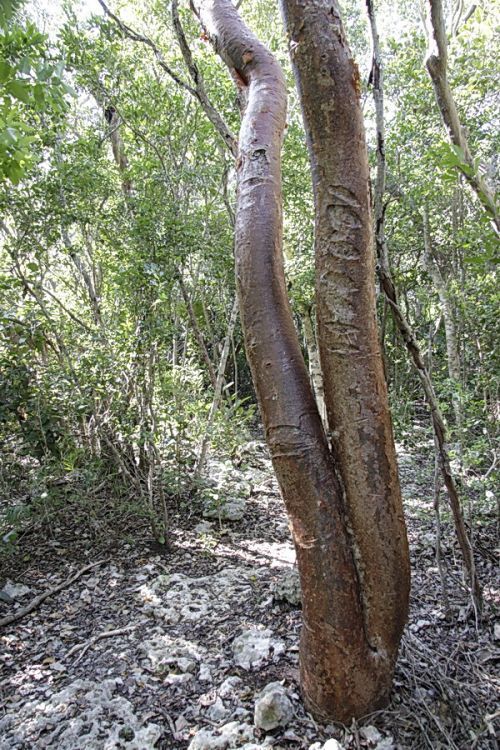
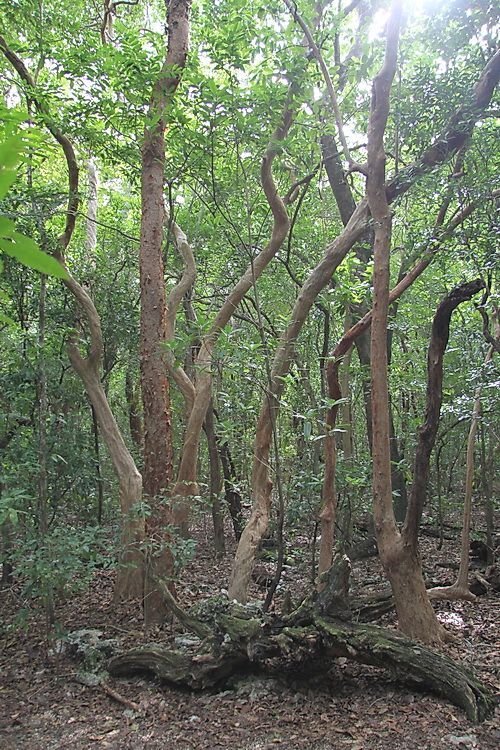
Las fotografías pertenecen a los fotógrafos que permiten su uso únicamente para fines de FNPS.
Información
Variantes de la comunidad:
Keys Rockland, Tropical Hammock
Descripción:
Rockland hammocks occur in subtropical climates on flatlands with limestone at or near the surface. These habitats often contain limestone solution features that create microhabitats and enhance overall diversity. They are generally mesic to dry-mesic communities where fire is rare.
The vegetation has strong tropical affinities and is adapted to highly calcareous substrates. Species diversity is exceptionally high: over 150 canopy and subcanopy species have been reported in some surveys (FNAI, 2010; USFWS, 2000). Species composition varies with climate, exposure to salt spray (or, in the Keys, the potential for saltwater inundation during storm surge), wind, and soil depth over limestone. Most canopy species are evergreen and not freeze-tolerant. Epiphytes are also common.
Keys Rockland Hammock is restricted to the Florida Keys. It occurs on limestone at or near the surface and is distinguished by vegetation with stronger Caribbean affinities and fewer continental species compared to mainland rockland hammocks.
Tropical Hammock in peninsular Florida tends to have more soil above the limestone. It contains fewer Caribbean species and more species from northern mainland habitats.
Shell Mounds are sometimes grouped with tropical hammocks due to their similar vegetation, but they differ in origin and substrate. These mounds were built by Indigenous peoples and are composed of shells rather than limestone. They are sometimes classified as maritime hammocks.
Excellent examples of rockland hammock occur in Everglades National Park, Collier-Seminole State Park, Curry Hammock State Park, Windley Key Geological State Park, Lignum Vitae Key State Park, and within Miami-Dade County preserves.
Referencias:
Bradley, K., & Gann, G. (1999). The pine rockland forests of southern Florida. The Palmetto, 19(2), 12–19. http://fnps.org/assets/pdf/palmetto/bradley_keith__george_gann_the_pine_rockland_forests_of_florida_vol_19_no_2_summer_1999.pdf
Duever, L. (1984, April). Florida’s natural communities: Rocklands. The Palmetto, 4(2), 8–11. http://fnps.org/assets/pdf/palmetto/duever_linda_conway_natural_communities_of_floridas_rocklands_vol_4_no_2_april_1984.pdf
Duever, M. J., Carlson, J. E., Meeder, J. F., Duever, L. C., Gunderson, L. H., Riopelle, L. A., Alexander, T. R., Myers, R. L., & Spangler, D. P. (1986). The Big Cypress National Preserve (Research Report 8). National Audubon Society.
Florida Department of Environmental Protection. (1992). Soil and water relationships of Florida's ecological communities. http://www.dep.state.fl.us/water/wetlands/delineation/docs/soil-and-water.pdf
Florida Natural Areas Inventory. (2010). Guide to the natural communities of Florida: 2010 edition. Florida Natural Areas Inventory. http://fnai.org/naturalcommguide.cfm
Gann, G. D., Bradley, K. A., & Woodmansee, S. W. (2009). Floristic inventory of South Florida database. Institute for Regional Conservation. http://regionalconservation.org/ircs/database/database.asp
Knight, G. R., Oetting, J. B., & Cross, L. (2011). Atlas of Florida's natural heritage: Biodiversity, landscapes, stewardship and opportunities. Institute of Science and Public Affairs, Florida State University.
Loope, L. L., Black, D. W., Black, S., & Avery, G. N. (1979). Distribution and abundance of flora in limestone rockland pine forests of southeastern Florida. South Florida Research Center, Everglades National Park.
Myers, R. L., & Ewel, J. J. (Eds.). (1990). Ecosystems of Florida. University of Central Florida Press.
U.S. Department of Agriculture, Soil Conservation Service. (1986). 26 ecological communities of Florida. http://ufdc.ufl.edu/UF00000110/00001
U.S. Fish and Wildlife Service. (2000). Multi-species recovery plan for South Florida: Tropical hammock. https://www.fws.gov/verobeach/MSRPPDFs/TropHammock.pdf
Whitney, E. N., Means, D. B., & Rudloe, A. (2004). Priceless Florida: Natural ecosystems and native species. Pineapple Press.
Haga clic para obtener más información sobre las diferentes comunidades de plantas de Florida o desplácese por la página para ver toda la maravillosa diversidad única que se puede explorar.
Tierras altas xéricas (muy secas)
Tierras altas algo secas
Tierras altas húmedas
Tierras rocosas
llanuras húmedas
Humedales de la cuenca
Humedales de filtración
Humedales con aguas de movimiento lento
Humedales de llanura aluvial
Arroyos
Lagos y estanques
Tierras altas costeras
Humedales costeros

