


Comunidades de plantas nativas de Florida
Scrub
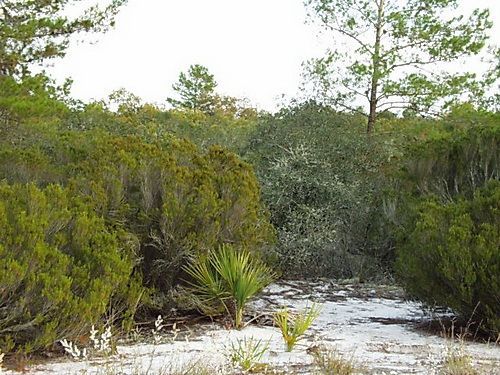
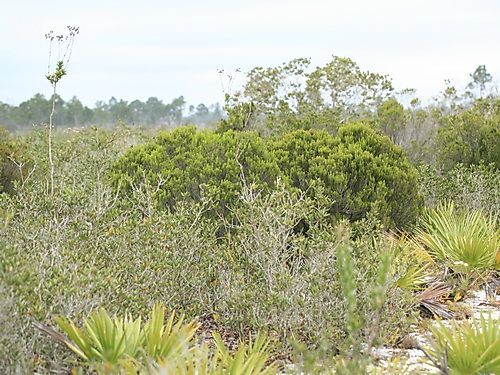
Las fotografías pertenecen a los fotógrafos que permiten su uso únicamente para fines de FNPS.
Información
Variantes de la comunidad:
Oak Scrub, Rosemany Scrub or Rosemary Balds, Sand Pine Scrub, Scrubby Sandhill
Descripción:
Scrub occurs across all of Florida’s climates—temperate, peninsular, and subtropical—on ancient dunes with deep, fine, excessively drained sands. This is a fire-dependent community with a natural fire return interval of 20–80 years. While scrub vegetation is relatively resistant to frequent fire, when burns do occur they are typically intense.
Scrub is characterized by sand pine ( Pinus clausa ), scrub oaks ( Quercus spp. ), Florida rosemary ( Ceratiola ericoides ), and lichens. Scrubs are often subcategorized based on the dominant species (e.g., sand pine scrub, oak scrub, rosemary scrub). The scrubs of the Lake Wales Ridge are among the oldest plant communities in North America and harbor exceptionally high numbers of rare and endemic species.
Scrub supports many endemic plant species, a high proportion of which are rare. Notable endemics include:
Scrub milkweed ( Asclepias curtissii )
Florida rosemary ( Ceratiola ericoides )
Garberia ( Garberia heterophylla )
Scrub rockrose ( Helianthemum nashii )
Scrub holly ( Ilex opaca var. arenicola )
Nodding pinweed ( Lechea cernua )
Scrub hickory ( Carya floridana )
Scrub palm ( Sabal etonia )
Sand pine ( Pinus clausa )
Approximately 45 plant species associated with scrub have been listed as endangered or threatened by the U.S. Fish and Wildlife Service (USFWS), most of them concentrated in the scrubs of the central ridges. Particularly rare species include Eryngium cuneifolium , Florida gayfeather ( Liatris ohlingerae ), four-petal pawpaw ( Asimina tetramera ), sandlace ( Polygonum dentoceras ), and Florida goldenaster ( Chrysopsis floridana ). Very rare species also occur in scrubby sandhill habitats, including several perennial Dicerandra species and Florida ziziphus ( Ziziphus celata ).
High-quality examples of ancient scrub can be found on the Lake Wales Ridge, including:
Archbold Biological Station
Lake June-in-Winter State Park
Highlands Hammock State Park
Lake Marion State Forest
Ocala National Forest
Bill Frederick Park (Orlando)
Additional excellent examples include coastal scrubs in the Panhandle (e.g., Topsail Hill State Park) and near Florida’s east coast (e.g., Jonathan Dickinson State Park).
Referencias:
Clewell, A. F. (1986). Natural setting and vegetation of the Florida Panhandle: An account of the environments and plant communities of northern Florida west of the Suwannee River (Report No. COESAM/PDEI-86/001). U.S. Army Corps of Engineers, Mobile District.
Duever, L. (1983, August). Florida’s natural communities: Inland sand ridges. The Palmetto, 3(3), 1–3, 10. http://fnps.org/assets/pdf/palmetto/duever_linda_conway_natural_communities_of_floridas_inland_sand_ridges_vol_3_no_3_aug_1983.pdf
Florida Department of Environmental Protection. (1992). Soil and water relationships of Florida’s ecological communities. http://www.dep.state.fl.us/water/wetlands/delineation/docs/soil-and-water.pdf
Florida Natural Areas Inventory. (2010). Guide to the natural communities of Florida: 2010 edition. Florida Natural Areas Inventory. http://fnai.org/naturalcommguide.cfm
Florida Natural Areas Inventory, & Florida Department of Natural Resources. (1990). Guide to the natural communities of Florida. Florida Natural Areas Inventory. http://fnai.org/PDF/Natural_Communities_Guide_1990.pdf
Laessle, A. M. (1958). The origin and successional relationship of sandhill vegetation and sand-pine scrub. Ecological Monographs, 28(4), 361–387. https://doi.org/10.2307/1942258
Myers, R. L., & Ewel, J. J. (Eds.). (1990). Ecosystems of Florida. University of Central Florida Press.
U.S. Department of Agriculture, Soil Conservation Service. (1986). 26 ecological communities of Florida. http://ufdc.ufl.edu/UF00000110/00001
Whitney, E. N., Means, D. B., & Rudloe, A. (2004). Priceless Florida: Natural ecosystems and native species. Pineapple Press.
Haga clic para obtener más información sobre las diferentes comunidades de plantas de Florida o desplácese por la página para ver toda la maravillosa diversidad única que se puede explorar.
Tierras altas xéricas (muy secas)
Tierras altas algo secas
Tierras altas húmedas
Tierras rocosas
llanuras húmedas
Humedales de la cuenca
Humedales de filtración
Humedales con aguas de movimiento lento
Humedales de llanura aluvial
Arroyos
Lagos y estanques
Tierras altas costeras
Humedales costeros

