



Comunidades de plantas nativas de Florida
Scrubby Flatwood
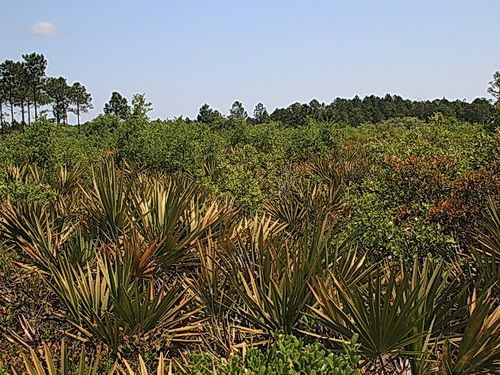
Las fotografías pertenecen a los fotógrafos que permiten su uso únicamente para fines de FNPS.
Información
Variantes de la comunidad:
N/A
Descripción:
Scrubby flatwoods are intermediate in character between scrub and flatwoods. They often occur on low rises within mesic flatwoods or in ecotones between flatwoods and scrub. Compared to scrub, scrubby flatwoods are less well drained, and their soils often contain a hardpan at depth.
These are fire-dominated communities, with natural fire return intervals of approximately 4–10 years.
Vegetatively, scrubby flatwoods are characterized by longleaf pine ( Pinus palustris ) or slash pine ( Pinus elliottii ), with an understory of scrub oaks and wiregrass ( Aristida stricta ). Tarflower ( Bejaria racemosa ) is also strongly associated with this community.
Scrubby flatwoods provide important habitat for several Florida endemics, including the Florida scrub-jay (Aphelocoma coerulescens ) and the Florida mouse ( Podomys floridanus ).
Referencias:
Duever, L. (1983, August). Florida's natural communities: Inland sand ridges. The Palmetto, 3(3), 1–3, 10.
Duever, L. (1984–1985, Winter). Florida's natural communities: Flatwoods. The Palmetto, 4(4), 6.
Florida Natural Areas Inventory. (2010). Guide to the natural communities of Florida: 2010 edition. Florida Natural Areas Inventory. http://fnai.org/naturalcommguide.cfm
— For scrubby flatwoods: https://www.fnai.org/PDF/NC/Scrubby_Flatwoods_Final_2010.pdf
Myers, R. L., & Ewel, J. J. (Eds.). (1990). Ecosystems of Florida. University of Central Florida Press.
U.S. Fish and Wildlife Service. (1999). South Florida multi-species recovery plan. U.S. Fish and Wildlife Service.
Whitney, E. N., Means, D. B., & Rudloe, A. (2004). Priceless Florida: Natural ecosystems and native species. Pineapple Press.
Haga clic para obtener más información sobre las diferentes comunidades de plantas de Florida o desplácese por la página para ver toda la maravillosa diversidad única que se puede explorar.
Tierras altas xéricas (muy secas)
Tierras altas algo secas
Tierras altas húmedas
Tierras rocosas
llanuras húmedas
Humedales de la cuenca
Humedales de filtración
Humedales con aguas de movimiento lento
Humedales de llanura aluvial
Arroyos
Lagos y estanques
Tierras altas costeras
Humedales costeros

