

Comunidades de plantas nativas de Florida
Strand Swamp
Las fotografías pertenecen a los fotógrafos que permiten su uso únicamente para fines de FNPS.
Información
Variantes de la comunidad:
N/A
Descripción:
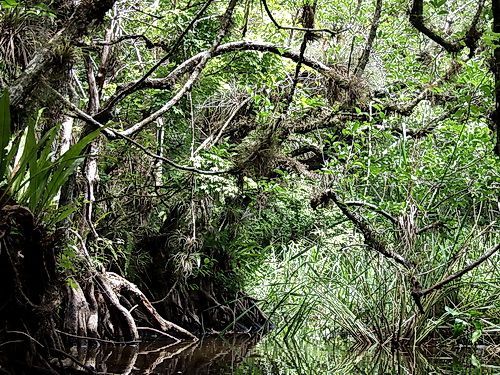
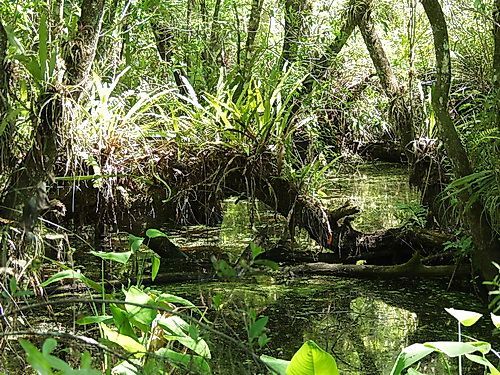
Strand swamps are shallow, forested, elongated depressions or channels that occur in troughs within flat limestone plains. During high water periods, they usually support some surface water flow. These channels often develop deep layers of peat over mineral substrates and have long hydroperiods.
Large strand swamps are typically dominated by bald cypress ( Taxodium distichum ), while smaller strands and shallow edges are more often dominated by pond cypress ( Taxodium ascendens ). Other common canopy and subcanopy species include red maple ( Acer rubrum ), pond apple ( Annona glabra ), swamp laurel oak ( Quercus laurifolia ), cabbage palm ( Sabal palmetto ), strangler fig ( Ficus aurea ), swamp bay ( Persea palustris ), sweetbay magnolia ( Magnolia virginiana ), and coastalplain willow ( Salix caroliniana ). Shrub layers may include wax myrtle ( Morella cerifera ), myrsine ( Myrsine cubana ), and buttonbush ( Cephalanthus occidentalis ).
The herbaceous layer often features string lily (Crinum americanum), giant leather fern (Acrostichum danaeifolium), toothed midsorus fern (Blechnum serrulatum), royal fern (Osmunda regalis), sawgrass (Cladium jamaicense), and waterhyssops (Bacopa spp.).
The warm, humid microclimate of southern strand swamps provides ideal habitat for epiphytic orchids and bromeliads. This community supports many rare species, most famously the ghost orchid (Dendrophylax lindenii).
Example Locations
Corkscrew Swamp Sanctuary (Audubon Society) – visitors can explore the boardwalk through the core of this strand swamp.
Big Cypress National Preserve
Fakahatchee Strand Preserve State Park
Referencias:
Austin, D. F., Jones, J. L., & Bennett, B. C. (1986, Summer). The Fakahatchee Strand. The Palmetto, 6(2), 3–6. http://fnps.org/assets/pdf/palmetto/austin_daniel_f_et_al_the_fakahatchee_strand_vol_6_no_2_summer_1986.pdf
Florida Department of Environmental Protection. (1992). Soil and water relationships of Florida's ecological communities. http://www.dep.state.fl.us/water/wetlands/delineation/docs/soil-and-water.pdf
Florida Natural Areas Inventory. (2010). Guide to the natural communities of Florida: 2010 edition. Florida Natural Areas Inventory. http://fnai.org/naturalcommguide.cfm
Gann, G. D., Bradley, K. A., & Woodmansee, S. W. (2009). Floristic inventory of South Florida database. Institute for Regional Conservation. http://regionalconservation.org/ircs/database/database.asp
Knight, G. R., Oetting, J. B., & Cross, L. (2011). Atlas of Florida's natural heritage: Biodiversity, landscapes, stewardship and opportunities. Institute of Science and Public Affairs, Florida State University.
Myers, R. L., & Ewel, J. J. (Eds.). (1990). Ecosystems of Florida. University of Central Florida Press.
U.S. Department of Agriculture, Soil Conservation Service. (1986). 26 ecological communities of Florida. http://ufdc.ufl.edu/UF00000110/00001
Whitney, E. N., Means, D. B., & Rudloe, A. (2004). Priceless Florida: Natural ecosystems and native species. Pineapple Press.
Haga clic para obtener más información sobre las diferentes comunidades de plantas de Florida o desplácese por la página para ver toda la maravillosa diversidad única que se puede explorar.
Tierras altas xéricas (muy secas)
Tierras altas algo secas
Tierras altas húmedas
Tierras rocosas
llanuras húmedas
Humedales de la cuenca
Humedales de filtración
Humedales con aguas de movimiento lento
Humedales de llanura aluvial
Arroyos
Lagos y estanques
Tierras altas costeras
Humedales costeros

