


Comunidades de plantas nativas de Florida
Depression Marsh
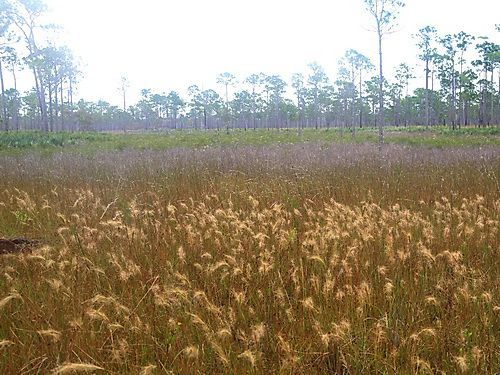
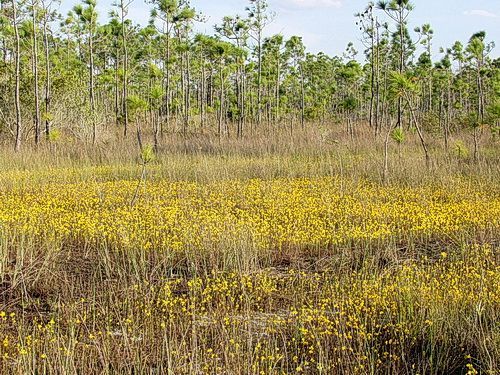
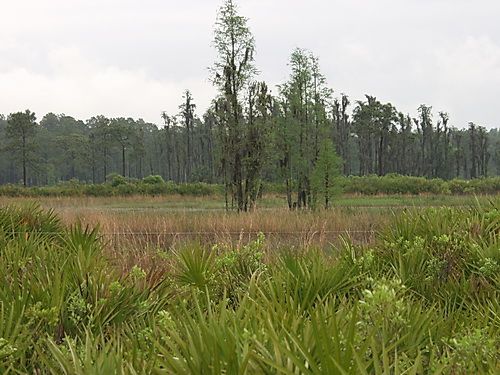
Las fotografías pertenecen a los fotógrafos que permiten su uso únicamente para fines de FNPS.
Información
Variantes de la comunidad:
Flatwoods Pond
Descripción:
Depression marshes—sometimes called flatwoods marshes—are small, rounded depressions in sandy substrates, often with peat accumulation toward the center. They are seasonally inundated still-water systems that occur in both subtropical and temperate settings. Fire is frequent to occasional and plays an important role in maintaining community structure.
Typical vegetation includes maidencane ( Panicum hemitomon ), fireflag ( Thalia geniculata ), pickerelweed ( Pontederia cordata ), and other emergent species. Frequently, vegetation is arranged in concentric zones, reflecting differences in hydroperiod: inner zones are often monospecific, while the outer transition zone into adjacent flatwoods supports high species diversity.
Referencias:
Clewell, A.F. 1986. Natural setting and vegetation of the Florida Panhandle - An account of the environments and plant communities of northern Florida west of the Suwannee River. Report No. COESAM/PDEI-86/001. United States Army Corps of Engineers, Mobile District, Alabama.
Florida Department of Environmental Protection. 1992. Soil and Water Relationships of Florida's Ecological Communities http://www.dep.state.fl.us/water/wetlands/delineation/docs/soil-and-water.pdf
Duever, Linda. 1987 (Summer-Fall). Florida's Natural Communities: Wet Prairies. The Palmetto 7, #2:6-7. http://fnps.org/assets/pdf/palmetto/v07i2p6duever.pdf
Florida Natural Areas Inventory (FNAI). 2010. Guide to the natural communities of Florida: 2010 edition. Florida Natural Areas Inventory, Tallahassee, FL. http://fnai.org/naturalcommguide.cfm
Gann, G.D., K.A. Bradley, and S.W. Woodmansee. 2009. Floristic Inventory of South Florida Database. Institute for Regional Conservation. http://regionalconservation.org/ircs/database/database.asp
Knight, G. R., J. B. Oetting, and L. Cross. 2011. Atlas of Florida's Natural Heritage - Biodiversity, Landscapes, Stewardship and Opportunities: Institute of Science and Public Affairs, Florida State University, Tallahassee, FL.
Myers, R.L. and J.J. Ewel (eds.). 1990. Ecosystems of Florida University of Central Florida Press: Orlando.
Simons, R.W. 1990. Terrestrial and freshwater habitats. Pages 99-157 in S.H. Wolfe, editor. An ecological characterization of the Florida Springs Coast: Pithlachascotee to Waccasassa Rivers. Biological Report 90(21). United States Fish and Wildlife Service, Washington, DC.
USDA Soil Conservation Service. 198_. 26 Ecological Communities of Florida. http://ufdc.ufl.edu/UF00000110/00001
Whitney, E.N., D. B. Means, A. Rudloe. 2004. Priceless Florida: Natural Ecosystems and Native Species. Pineapple Press.
Haga clic para obtener más información sobre las diferentes comunidades de plantas de Florida o desplácese por la página para ver toda la maravillosa diversidad única que se puede explorar.
Tierras altas xéricas (muy secas)
Tierras altas algo secas
Tierras altas húmedas
Tierras rocosas
llanuras húmedas
Humedales de la cuenca
Humedales de filtración
Humedales con aguas de movimiento lento
Humedales de llanura aluvial
Arroyos
Lagos y estanques
Tierras altas costeras
Humedales costeros

