

Nomenclature
Common Name:
Synonym(s):
Genus species:
Family:
Asteraceae (Compositae)
Plant Specifics
Form:
Size:
Life Span:
Long-lived perennial
Flower Color:
Fruit Color:
Phenology:
Noted For:
Landscaping
Recommended Uses:
Considerations:
Availability:
Propagation:
Light:
Moisture Tolerance:
Always Flooded------------------------------------------------Extremely Dry
Coming Soon!
Not wet but not extremely dry ---to--- Very long very dry periods
Salt Water Flooding Tolerance:
Unknown
Salt Spray/Salty Soil Tolerance:
Low/no tolerance of salty wind or direct salt spray
Soil or Other Substrate:
Sand
Soil pH:
Suitable to Grow In:
Ecology
Wildlife:
Attracts a variety of butterflies, including gulf fritillary, for nectar.
Attracts many native insects , especially bees including miner , sweat metalic sweat , resin, leaf-cutter, nomad, long-horned, bumble , and carpenter bees.
The endemic ground-dwelling bee, Hesperapis or balduina bee ( Hesperapis oraria ), is dependent on this species.
Attracts the non-native but economically important honey bee.
Native Habitats:
Natural Range in Florida:
Visit the USF Libraries Atlas of Florida Plants
Comments:
Ethnobotany:
General Comments:
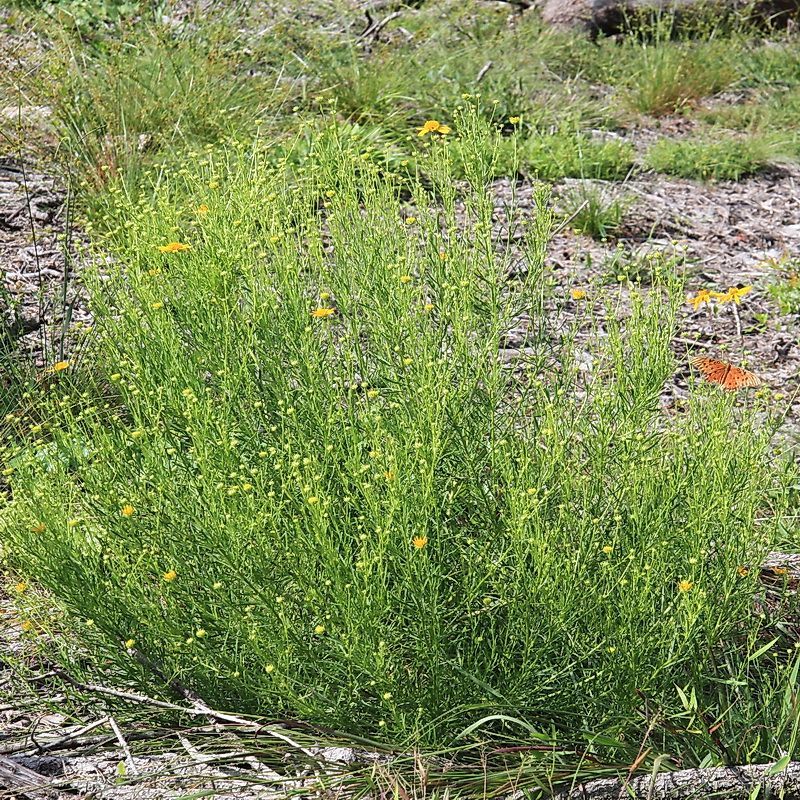
The first year, this plant is a small rosette. The second year, it grows in height and flowers.
Balduina angustifolia is endemic to the southeastern coastal plain from Mississippi to Georgia with most of its range being within Florida (BONAP 2014).
Archbold bee study (scientific names)
Attracts many insects , especially bees including Perdita bequaerti, Agapostemon splendens, Augochlora pura, Augochlorella aurata, Augochloropsis sumptuosa, Dialictus coreopsis, D. miniatulus, D. nymphalis, D. placidensis, D. tegularis, Evylaeus pectoralis, Halictus ligatus, Nomia heteropoda, Anthidiellum notatum rufimaculatum, A. perplexum, Coelioxys dolichos, C. germana, C. mexicana, C. sayi, C. texana, Megachile albitarsis, M. brevis pseudobrevis, Mgeorgica, M. inimica, M. mendica, M. petulans, M. policaris, M. pruina, M. texana, M. xylocopoides, Dolichostelis louisae, Trachusa fontemuitae, Nomada fervida, Svastra aegis, Apis mellifera, Bombus impatiens, B. pennsyl.uanicus, Xylocopa micans, and X. virginica krombeini (Deyrup et al. 2002).

