


ECOACTION ALERTS
Your Voice for Florida’s Native Plants Matters
© Photo by Ethan Liu
SIGN UP FOR ECO ACTION ALERTS
Active Alerts
We are actively tracking policy across the state - sign up to be notified when your voice can help protect native plants and native plant communities!
Help Us Protect Florida's National Forests
 Submit a Comment
There is an impending threat to our national forests. A serious and far-reaching threat. Not JUST in Florida, but across the entire United States. The U.S. Department of Agriculture is preparing to rescind the Roadless Area Conservation Rule (Roadless Rule) that provides extra protection to the 45 million acres of our national forest system that have been designated as Inventoried Roadless Area (hereby referred to as Roadless Area). We all have until October 6 to file our objections!
What Is the Roadless Rule?
It is no exaggeration to describe the Roadless Rule as one of the most important land conservation measures enacted in our lifetimes. It provides an additional layer of protection from clearcut logging and road construction in approximately 45 million acres of unfragmented, pristine national forest land. Those 45 million acres designated as Roadless Area account for only 30 percent of the total national forest system. Since its creation in 2001, the Roadless Rule has preserved stands of old-growth forest, protected essential habitat for sensitive wildlife, and provided outstanding recreational opportunities by restricting clearcut logging and the construction of new roads.
The Roadless Rule has been overwhelmingly popular with the American public, who submitted more than 600,000 comments opposing the proposal to rescind it when it was initially announced. Despite its popularity, the Roadless Rule has faced relentless attacks from logging, mining, and other commercial interests that want unhindered access to exploit OUR natural resources.
What is Under Threat in Florida?
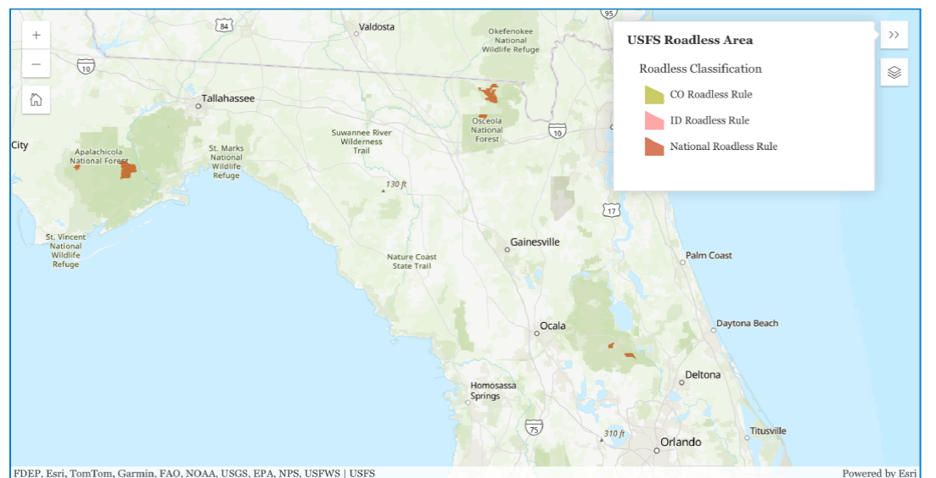
Florida is home to three national forests: the Apalachicola, Osceola and Ocala. Combined, they span about 1.2 million acres. Only 50,000 of those acres, or 4 percent of the total, have been designated as Roadless Area. This map illustrates the limited total extent of Roadless Area in Florida.
We want to retain the extra level of protection the Roadless Rule confers to those 50,000 acres. It’s important to understand the Roadless Rule does not put the protected areas into a lockbox. Virtually all those lands are open for compatible recreation and there is a process in place to allow such things as selective logging, and even road construction, when it is determined to be necessary to reduce wildfire risk or otherwise improve forest health. The industries that want the Roadless Rule rescinded simply want to remove ALL BARRIERS to their exploitation of our national forests.
What Can You Do?
FNPS has submitted another letter for the second round of comments opposing the proposal to rescind the Roadless Rule, and we are asking our members to participate in the fight by uploading personal comments on the portal being used to receive such comments by the October 6 deadline! You can compose your comments when you enter the portal, or write them up in advance and paste them into the window provided for comments after you click the blue “comment” button. You can also review our first letter.
Many of the comments already submitted say little more than “don’t rescind the Roadless Rule”. You comment will be more effective if you include something more substantial. Point out some specific issues or explain why protection of these areas is important to you, Your comments do not need to be long or steeped in science.
Consider some of these points:
- The Roadless Rule does not prevent all logging or new road development in designated Roadless Areas. It simply requires some additional assessment and process to ensure the sensitive natural resources protected within them receive extra consideration to avoid reckless and short-sighted decisions made on behalf of commercial interests.
- Roadless areas in Apalachicola National Forest support some finest remaining stands of old growth longleaf pine, botanically unique pitcher plant savannas that are extraordinarily sensitive to even sight changes in hydrology, and the largest remaining population of the threatened Red-cockaded woodpecker.
- Roadless areas in Ocala National Forest help protect the largest sand pine scrub ecosystem in the world, the largest remaining population of the threatened Florida scrub jay and encompass much of the springshed of Alexander Springs – one of the only pristine springs remaining in Florida.
- The unaltered wetland habitats in Florida’s roadless areas are critically important to species like the flatwoods salamander and others that are very sensitive to hydrologic impacts that result from logging and roadbuilding.
- The Forest Service’s own research demonstrates road development in natural areas is a significant vector for the introduction of invasive species and that wildfire frequency also increases with road density.
- Florida’s national forests are home to 136 plant species and 36 animal species designated as either threatened or endangered. Many of these species would be put at even greater risk by expanded logging, mining, and other resource extraction.
Submit your comments via the Regulations.gov website by the October 6 deadline. If this link (portal) does not take you directly to the comment page, then go to https://www.regulations.gov/ and enter the docket number RIN 0596–AD66 into the search window.
Expired Alerts
Just Follow the Law – Fund Florida Forever
In 2023, the Florida Legislature passed a law requiring that a minimum of $100 million annually be allocated to the Florida Forever program. They have violated their own law every year since.
The Florida Legislature will reconvene for a special session next week to approve a final budget for the 2026-2027 fiscal year. They failed, once again, to pass a final budget during the regular legislative session. Please contact the leadership and members of the Joint Legislative Budget Commission listed below and demand that the budget include at least the minimum of $100 million that they committed to allocate annually, BY LAW, in 2023.
You’ve heard us say this before: preserving land is the single most effective strategy for conserving native plants and the natural communities that sustain them. Yet the current budget proposal submitted by the Senate proposes only $35 million for Florida Forever, while the House prefers to zero out Florida Forever funding entirely! We are all witnesses to the rampant development now consuming rural Florida, and what remains of our unprotected native plant habitat, at a breakneck pace. It is more important than ever that Florida Forever receive the funding necessary to counter what is being lost to the bulldozers every day.
In contrast to the Legislature’s unwillingness to properly fund Florida Forever, the Senate proposes spending $200 million, and the House $300 million, on the Rural and Family Lands Protection Program (RFL). RFL funds can only be used to buy easements that prevent agricultural land from being developed. Florida Forever is the only state program that buys land to conserve nature. Although FNPS considers RFL to be an important companion program to Florida Forever, it is not a substitute. Both Florida Forever and RFL need to be funded!
Please email or phone the leaders and members of the Joint Legislative Budget Commission listed below before Tuesday May 12, 2026. If your own Senator or Representative is listed as a member, it would be especially valuable for you to contact them and identify yourself as a constituent. Tell these legislators to simply comply with the law they passed themselves in 2023 by providing a minimum of $100 million to the Florida Forever land conservation program.
Joint Legislative Budget Commission - Contact Information
| Name | Phone | |
|---|---|---|
| President Ben Albritton | Albritton.Ben@flsenate.gov | (850) 487-5229 |
| Speaker Daniel Perez | Daniel.Perez@myfloridahouse.gov | (850) 717-5000 |
| Senator Ed Hooper | Hooper.Ed@flsenate.gov | (850) 487-5021 |
| Senator Lori Berman | Berman.Lori@flsenate.gov | (850) 487-5026 |
| Senator Jim Boyd | Boyd.Jim@flsenate.gov | (850) 487-5020 |
| Senator Jason Brodeur | Brodeur.Jason@flsenate.gov | (850) 487-5010 |
| Senator Gayle Harrell | Harrell.Gayle@flsenate.gov | (850) 487-5031 |
| Sen Kathleen Passidomo | Passidomo.Kathleen@flsenate.gov | (850) 487-5028 |
| Senator Darryl Rouson | Rouson.Darryl@flsenate.gov | (850) 487-5016 |
| Rep Lawrence McClure | Lawrence.McClure@myfloridahouse.gov | (850) 717-5068 |
| Rep Alex Andrade | Alexander.Andrade@myfloridahouse.gov | (850) 717-5002 |
| Rep Demi Busatta | Demi.Busatta@myfloridahouse.gov | (850) 717-5114 |
| Rep Jason Shoaf | Jason.Shoaf@myfloridahouse.gov | (850) 717-5007 |
| Rep John Snyder | John.Snyder@myfloridahouse.gov | (850) 717-5086 |
| Rep Allison Tant | Allison.Tant@myfloridahouse.gov | (850) 717-5009 |
| Rep Marie Woodson | Marie.Woodson@myfloridahouse.gov | (850) 717-5105 |
Restore the Ocklawaha River
Please take a minute to contact Senate President Albritton and ask him to allow SB 1066, entitled Tributaries of the St Johns River, to be heard on the Senate Floor.
Don’t let the name of the bill confuse you. This legislation is about restoring the Ocklawaha River – finally, a full 57 years after it was impounded by a dam that drowned 7,500 acres of floodplain forest and at least 20 springs and spring-run streams, robbed the downstream St Johns River of more than 150 million gallons of freshwater inflow every day since it was constructed in 1968, and became obsolete just one year later when President Nixon deauthorized the Cross Florida Barge Canal boondoggle in 1969.
We have never been so close to success. We just need Senate President Albritton to let SB 1066 come to a vote on the floor of the Florida Senate. It has already cleared every other hurdle, including resounding votes of support by three different Senate committees. The 2026 legislative session is nearly over, and there is a chance SB 1066 will not be put to a vote unless Senator Albritton understands that it is a real priority for the people of Florida. It would be tragic if the bill failed to be heard by the full Senate when we are this close.
Restoration of the Ocklawaha would:
Allow the regeneration of 7,500 acres of floodplain forest.
Free at least 20 springs, and plant-rich spring-run streams, that were drowned under the Rodman Reservoir.
Return 150 million gallons of freshwater flow every day to the St Johns River.
Restore historic spawning habitat for striped bass, sturgeon and American shad
Expand recreational access, to increase the economic benefits to surrounding communities
The fisheries value of the Rodman Reservoir has often been praised and touted as sufficient reason to retain the Reservoir; however, the recreational and economic values of Rodman’s fishery would be dwarfed by that of a restored Ocklawaha/St Johns system. Restoring 150 million gallons of flow daily to the downstream St Johns River would set the stage for the grassbeds and other aquatic vegetation to recover and impede the saltwater intrusion now degrading the river.
Remind Senator Albritton that an assessment conducted by Florida Tax Watch concluded restoration of the Ocklawaha is the environmentally and fiscally responsible choice. And let him know that presiding over passage of SB 1066 would be an exemplary way to seal his legacy as President of the Florida Senate.
Please phone Senator Albritton’s office at either (850) 487-5027 or (850) 487-5229 by next Monday, March 9. Leave a voicemail message if you don’t reach a person. Or consider sending a quick email instead to Albritton.Ben@flsenate.gov A few sentences is enough to let him know you support passage of SB 1066.
Stop “Blue Ribbon Projects” before they consume native plant habitat and what remains of rural Florida!
We are all witnesses to the rampant development now consuming rural Florida, and what remains of our unprotected native plant habitat, at a breakneck pace. Local government control over how and where development takes place is one of the few tools available to help minimize the losses. Now the state is preparing to pass a law that will take away local control of development decisions across vast areas and put the developers themselves in charge.
A bill entitled “Blue Ribbon Projects” would allow any developer who owns or controls a land area of 10,000 acres or more to decide when and how their land is developed. That is a land area exceeding 15 square miles – enough land to develop an entirely new city! Your local government and its residents, meaning you, could be cut out of the growth management decision-making process unless you let lawmakers know you oppose this legislation NOW.
The Senate Rules Committee will be considering this bill when they meet next Tuesday morning – March 3 – and that is our best remaining opportunity to prevent it from becoming law. Contact information for the members of the committee is provided below. Please use the contact information provided below to phone or email the members of the Senate’s Rules Committee – before Monday afternoon! - and tell them to vote “no” on SB 354, Blue Ribbon Projects, because:
Blue Ribbon Projects would be a sprawl-inducing monster that puts vast swaths of rural Florida under direct control of the development industry.
You object to the continuing erosion of local government authority to manage growth and development because tax-paying residents deserve to have a strong voice in decisions so fundamental to the future character and livability of their local communities.
The rate at which we are losing our natural areas and agricultural lands is unsustainable and demands greater control - not less control - over development decisions.
You support the legislature’s efforts to protect what remains of natural Florida and of our agricultural land base, but legislation like this works directly against those efforts and is completely contradictory to their support of a program like the Rural and Family Lands Protection Program.
If you believe the development industry already has too much power in Florida, then NOW is the time to take a stand against this effort to seize COMPLETE CONTROL. The Blue Ribbon Projects legislation has skated towards final approval in the House of Representatives. This truly is our best opportunity to prevent it from becoming law. Please contact as many of the members of the Senate Rules Committee as possible using the contact info below. If you choose to make a phone call and end up reaching a full voice-mailbox, please try sending a brief email instead. If your Senator is included in the list below, it is doubly important for you to contact them and identify yourself as a constituent. Nothing less than the ability to influence the future character, livability and environmental health of your community is at stake.
Senator Kathleen Passidomo, Chair Passidomo.Kathleen@flsenate.gov (850) 487-5028
Senator Shevrin Jones, Vice-Chair Jones.Shevrin@flsenate.gov (850) 487-5034
Senator Bryan Avila Avila.Bryan@flsenate.gov (850) 487-5039
Senator Lori Berman Berman.Lori@flsenate.gov (850) 487-5026
Senator Jim Boyd Boyd.Jim@flsenate.gov (850) 487-5020
Senator Jennifer Bradley Bradley.Jennifer@flsenate.gov (850) 487-5006
Senator Danny Burgess Burgess.Danny@flsenate.gov (850) 487-5023
Senator Colleen Burton Burton.Colleen@flsenate.gov (850) 487-5012
Senator Tracie Davis Davis.Tracie@flsenate.gov (850) 487-5005
Senator Nick DiCeglie DiCeglie.Nick@flsenate.gov (850) 487-5018
Senator Don Gaetz Gaetz.Don@flsenate.gov (850) 487-5001
Senator Ileana Garcia Garcia.Ileana@flsenate.gov (850) 487-5036
Senator Erin Grall Grall.Erin@flsenate.gov (850) 487-5029
Senator Gayle Harrell Harrell.Gayle@flsenate.gov (850) 487-5031
Senator Ed Hooper Hooper.Ed@flsenate.gov (850) 487-5033
Senator Jonathan Martin Martin.Jonathan@flsenate.gov (850) 487-5033
Senator Rosalind Osgood Osgood.Rosalind@flsenate.gov (850) 487-5032
Senator Jason Pizzo Pizzo.Jason@flsenate.gov (850) 487-5037
Senator Ana Maria Rodriguez Rodriguez.AnaMaria@flsenate.gov (850) 487-5040
Senator Darryl Rouson Rouson.Darryl@flsenate.gov (850) 487-5016
Senator Cory Simon Simon.Cory.web@flsenate.gov (850) 487-5003
Senator Jay Trumbull Trumbull.Jay@flsenate.gov (850) 487-5002
Senator Tom Wright Wright.Tom@flsenate.gov (850) 487-5008
SB 290 & HB 433 Threaten the Future of Florida’s Conservation Land
If you thought the Legislature’s approval of the State Parks Preservation Act last year meant the future of our public lands was secure – think again. Thousands of acres of “protected” conservation land are now at risk of being sold back into private ownership to be used for agriculture! Legislation that would allow this has already been approved by all the Senate committees that reviewed it and appears poised to fly through the House as well. Final passage by both the full Senate and House could take place as early as this Friday.
Please phone or email Senate President Ben Albritton and House Speak Daniel Perez IMMEDIATELY. Tell President Albritton you oppose SB 290, and tell Speaker Perez you oppose HB 433, both of which are entitled Florida Department of Agriculture and Consumer Services.
Senate President Ben Albritton: Albritton.Ben@flsenate.gov or (850)487-5229
House Speaker Daniel Perez: Daniel.Perez@myfloridahouse.gov or (850)717-5000
Florida’s conservation lands are acquired to protect water resources, preserve habitat for native plants and wildlife, provide public access for compatible recreational enjoyment, and help ensure a healthier and more sustainable future.
Senate Bill 290 and House Bill 433 include a provision that would direct the state to sell off conservation lands that could be used for “bona fide agricultural purposes”, while retaining a Rural and Family Lands Protection Program (RFLPP) agricultural easement. RFLPP easements allow natural areas on the “protected” property to be converted for agricultural use, and areas already used for relatively passive agricultural uses, like cattle grazing and timber production, could be converted to more intensive agricultural uses – like the row crop visible in the photo – entirely at the discretion of the “new” private landowner. Does that look or sound like “conservation” to you?
Take a moment to let this sink in!
Lands selected for protection using Florida Forever’s science-based assessment process, and purchased using taxpayer dollars, could be liquidated and converted to row crops. We all must eat and FNPS has always supported the RFLPP program that helps ensure we will always be able to feed ourselves. But it cannot replace Florida Forever and we must once again stand in defense of land conservation.
At first glance, these bills may not appear to be so bad. State Parks, State Forests and Wildlife Management Areas would be exempt as currently drafted; however, where will the State Parks, State Forests and WMAs of the future come from? Those designations are often not conferred until long after the lands initially acquired, and this legislation would require all newly acquired lands to be sold as “surplus” if someone determines they could be used for agriculture.
Why bother going through the expensive and time-consuming process of purchasing the land in the first place? And if you are a landowner who wants to sell your property to the state because you want to know it will be conserved in perpetuity, how could you ever trust the state to follow through on that commitment?
As members of the Florida Native Plant Society, we know that conservation land is more than acreage on a map — it is living habitat, native plant diversity, hydrologic function, ecological resilience and spiritual nourishment.
To add insult to injury, the funds generated by selling Florida Forever land back into private ownership would not be used to purchase more Florida Forever land, but to purchase more RFLPP agricultural easements. This is a transparent attempt to liquidate Florida Forever lands in order to fund RFLPP.
Even if existing Parks, Forests, and WMAs are shielded, this legislation would create a pathway to surplus future conservation land and set a dangerous precedent.
These are long bills that include many things FNPS could support. But not at the expense of the future of land conservation. Please use the contact info provided above to phone or email Senate President Ben Albritton and House Speaker Daniel Perez BEFORE FRIDAY and tell them you object strongly to the land surplussing provisions included in Section 8 of SB 290 and HB 433. Demand those provisions either be deleted, or the bill rejected in its entirety.
FNPS supports the NO BUILD option for a new toll road in Hardee County near Archbold Biological Station
Release Date: 2026-02-12
Action Deadline: 2026-02-16
Today we sent a letter to the Florida Department of Transportation supporting the NO BUILD option for a proposed toll road in a critical area of the Florida wildlife corridor.
Please consider submitting your own comment recommending the NO BUILD option for this potentially highly destructive new toll road.
FNPS urges Martin County's Representative Snyder to support land conservation funding
Release Date: 2026-02-09
Action Deadline: 2026-02-16
Today we sent an email urging Martin County's State Representative John Snyder to support full funding of Florida Forever, Florida's premier land conservation program. We encourage all Floridians, but particuarly Martin County residents, to call and email Rep. Snyder to express their support for Florida Forever funding.
Dear Representative Snyder:
The Florida Native Plant Society’s 6,000+ members were grateful for the leadership you displayed last year that culminated in successful passage of the State Parks Preservation Act. To build further upon that leadership and success in the name of protecting natural Florida, we now ask that you ensure the Florida Forever land conservation program is fully funded in the 2026-2027 budget. As Chair of the House Agriculture and Natural Resources Budget Subcommittee, you will wield tremendous influence over the upcoming decisions related to Florida Forever funding.
I have attached an information sheet that summarizes why Florida Forever is so essential to protecting our natural heritage. Importantly, it also highlights the fundamental differences between Florida Forever and the Rural and Family Lands Protection Program (RFLPP). FNPS recognizes the need for both programs because Florida needs to protect both our best remaining natural areas AND the agricultural production that contributes so significantly to our economy, rural communities and national security. The legislature’s apparent preference for funding RFLPP over Florida Forever does not seem to recognize that these land protection programs are complementary, not redundant nor in competition with one another. It is the combination of the two that will secure a sustainable future for our state.
FNPS believes full funding for Florida Forever means matching the historical level of $300 million annually. This is especially important given the fact that the cost of land has increased so greatly, as has the pace of the development that is consuming Florida’s natural areas AND agricultural lands. Florida’s voters have consistently supported land conservation. Please join with those voters by supporting FULL FUNDING for Florida Forever.
Respectfully,
Eugene Kelly, President
Florida Native Plant Society
Stop three bad sprawl bills!
Release Date: 2026-01-30
Action Deadline: 2026-02-06
Land development is consuming native plant habitat at an alarming rate. Minimizing the loss of that habitat by controlling where and how development occurs is one of the few tools available to us for conserving native plants and other sensitive natural resources. If you believe the development industry itself appears to be calling most of the shots, you are not mistaken. The Legislature has been progressively eroding the Home Rule authority of our local governments, including the ability to preside over land use decision-making, through “preemption”, whereby they take that authority away from your local elected officials - often at the behest of developers.
The Florida Legislature is considering a series of bills that threaten to end the last remaining vestiges of your local government’s authority to manage growth and development, and with it your ability to have any influence over the future character, livability and environmental health of your community. If you are outraged by the evident absence of any real control over development in Florida – you haven’t seen anything yet!
The three bills summarized below may, collectively, be the knock-out punch that effectively ends meaningful growth management in Florida:
Senate Bill 354(by McClain) and House Bill 299(by Melo) entitled Blue Ribbon Projects.
Talk about a misnomer! This would allow anyone who controls a contiguous land area of at least 10,000 acres (more than 15 square miles) to bypass all comprehensive planning, zoning and land use regulations if they agree to reserve 60 percent of the land area for environmental protection, agriculture, recreation and/or utilities development. The entire “reserve area” could be agriculture. Undevelopable wetlands would count as environmental protection. Development rights would be vested for at least 50 years, allowing creation of entire new cities without ANY control by elected officials or input from residents. If this sounds like a bill that developers who have already consolidated ownerships larger than 10,000 acres wrote for themselves, that’s because it is.
SB 686(by McClain) and HB 691(by Botana) entitled Agricultural Enclaves
Owners of parcels less than 1,280 acres that have been in agricultural use for at least five years, and that adjoin developed parcels along at least 75 percent of the property line, can apply to the local government to be certified as an Agricultural Enclave. If the certification is approved, the property owner can develop single-family residential housing equivalent to that allowed on adjacent parcels and the local government cannot enact or enforce regulations that are more burdensome than for other comparable uses or densities. For a parcel less than 700 acres in size, only 50 percent of the parcel boundary must be subject to planned development to be certified as an Agricultural Enclave. If any boundary area adjoins an urban service area, the service area is automatically extended to encompass the Enclave. In effect, an Agricultural Enclave is granted development rights equivalent those on adjoining parcels already approved for development without any local government oversight or public comment.
SB 718(by McClain) entitled Water Management
This legislation would prohibit local governments from adopting any ordinances, regulations or policies related to water quality or quantity, pollution prevention, or wetlands protection and preempt such authority to the state. Meaning local governments could no longer choose to be more protective of their water resources and wetlands than the state. It would also repeal requirements for the water management districts to conduct land management reviews on lands conservation lands they own and manage.
The cumulative impact of these bills would be an expansion of urban sprawl, accelerated loss of agricultural land and wetlands to development, more degradation of water quality, and loss of habitat for native plants and wildlife. We have an opportunity to stop these bills before they advance all the way to a floor vote in either the Senate or House of Representatives.
Phone or email your legislators and tell them:
You object specifically to Senate Bills 354 (Blue Ribbon Projects), 686 (Agricultural Enclaves) and 718 (Water Management) when addressing your senator, and House Bills 229 (Blue Ribbon Projects) and 691 (Agricultural Enclaves) when addressing your representative.
You object to the legislature’s continuing preemption of local government authority to manage growth and development, and to be more protective on their natural resources than the state.
The legislature’s erosion of growth management, and the sprawl it is inducing in Florida’s rural areas, is in direct conflict with their stated objective to support agriculture and maintain our base of agricultural lands. Sprawl = Loss of Agriculture!
Contact information for your legislators can be found at https://www.flsenate.gov/Senators/Find
and https://www.flhouse.gov/FindYourRepresentative. A quick phone call or email at this early stage of the legislative session may help stop these bad bills before they gain any traction. Be sure to identify yourself as a constituent!
Help Us Protect Florida's National Forests
FNPS members need to be aware of an impending threat to our national forests. Not JUST in Florida, but across the United States. The U.S. Department of Agriculture has begun the process of rescinding the 2001 Roadless Rule to make it easier for industry to exploit the natural resources protected in those Roadless areas.
What Is the Roadless Rule?
Possibly the most important land conservation measure of our lifetime, the Roadless Rule protects approximately 45 million acres of unfragmented, pristine national forest lands across the entire US by banning clearcut timber harvests and the construction of damaging new roads. The ban on road construction also means protection from mining and other extremely destructive exploitation.
Since its creation in 2001, the Roadless Rule has preserved centuries-old stands of old-growth trees from logging, protected essential habitat for sensitive wildlife, provided abundant recreational opportunities for humans and maintained functioning watersheds. It has also become increasingly important for providing critical buffers against climate change.
The Roadless Rule has been overwhelmingly popular with the American public, who wanted backcountry wild lands within the forest system protected for wildlife and people alike - and also wanted to end roadbuilding that benefited the timber industry at the expense of taxpayers.
Despite its popularity, the Roadless Rule has faced relentless attack from logging and resource extraction interests and political forces. In this latest attempt to undermine Roadless protections, the Trump administration has announced an official rulemaking process to rescind the Roadless Rule, laying the groundwork for a major increase in industrial logging and other commercial exploitation.
What is Under Threat in Florida?
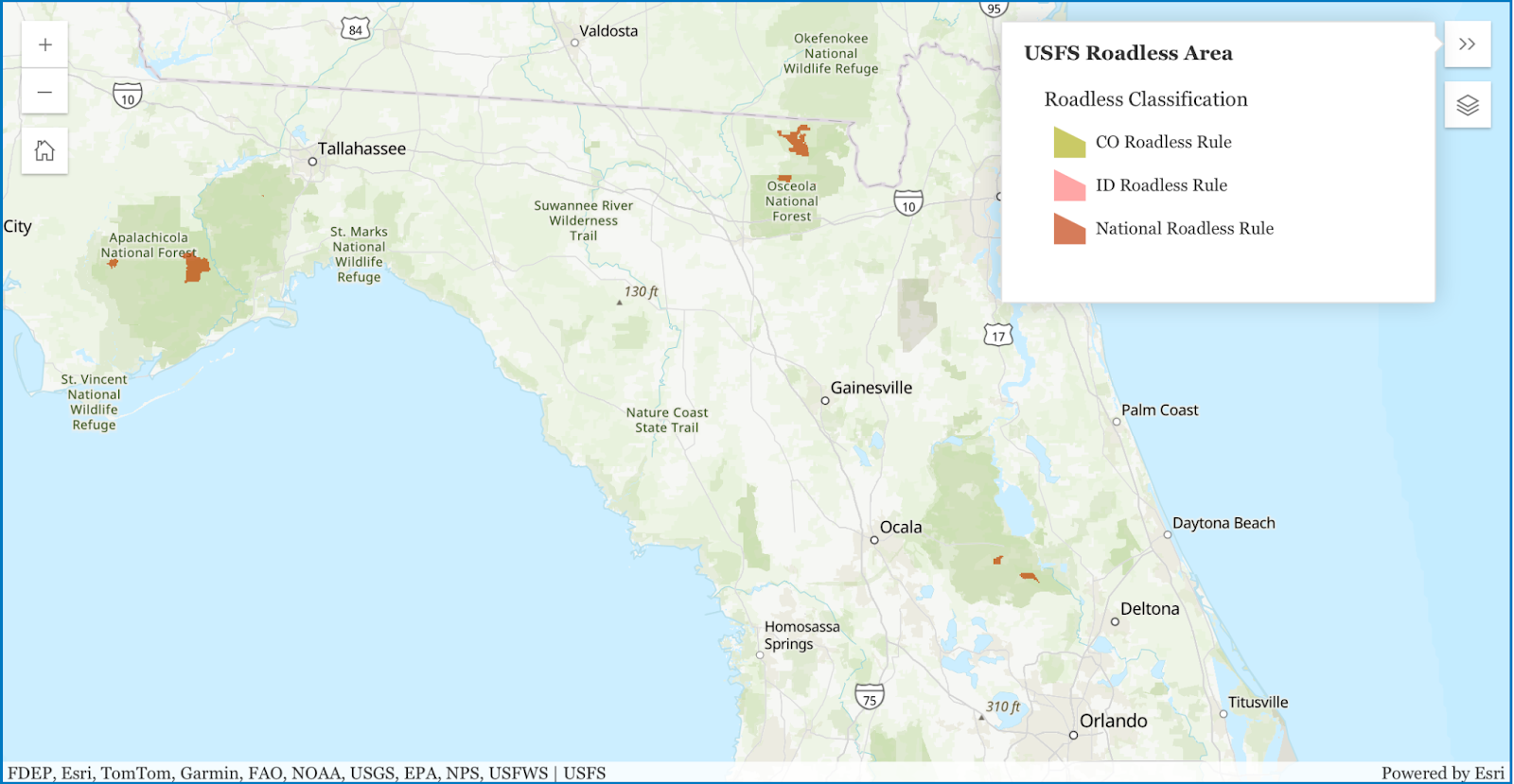
Florida is home to three national forests: the Apalachicola, Osceola and Ocala. Combined, these national forests span almost 1.2 million acres, protecting about 500,000 acres of wetlands, 85,000 acres of designated federal wilderness and 1,400 miles of recreational trails that host more than 1.1 million visitors every year. Florida’s national forests are also home to 14 at-risk animal species, dozens of threatened and endangered plant species, and sensitive native plant communities that could be harmed by destructive alteration and intrusion into roadless areas. Unfortunately, a total of only 72,000 acres in our three national forests are currently protected under the Roadless Rule. See the map above or click here to see a map of all US land protected by this rule.
We Floridians want to retain the extra level of protection conferred by the Roadless Rule. That includes a large portion of the Juniper Springs springshed in Ocala National Forest. Juniper is one of the least polluted springs in Florida thanks to Roadless Rule protection. It’s important to keep in mind there is a process in place to allow exceptions to Roadless Rule protections to allow such things as selective logging when necessary to reduce wildfire risk or otherwise improve forest health. The industries that want the Roadless Rule rescinded simply want to remove ALL BARRIERS to their exploitation of our natural areas.
What Can You Do?
FNPS will fight against the unraveling of this crucial conservation safeguard, and we would like our members to take part. These lands belong to all Americans, not to the commercial logging and mining interests that want an open door to exploit them.
You can help by participating in the public comment period BEFORE Sept. 19.
Here’s a quick rundown of the process:
On August 29, the US Forest Service published a notice of intent to prepare an environmental impact statement (EIS) on rescinding the Roadless Rule.
Doing so opened the initial public comment period, which ends on September 19.
Once the public comment period is over, the agency must review the comments and address substantial issues raised by comments in the EIS.
In the spring, USDA will publish a new draft rule alongside a draft EIS. This will come with a second comment period.
Everything will get revised based on the second comment period and a final rule will be published late in 2026 — the objective here being that the new rule will rescind the Roadless Rule.
Writing An Effective Public Comment
To have the best chance at influencing this process, write substantial, unique comments targeted at expanding the scope of the environmental impact statement. Your comments don’t have to be long or steeped in science.
Here is the basic formula for writing the most effective comment:
Uniqueness
Introduce yourself. Including = any credentials you may have..
Explain why roadless areas in our national forests matter to you.
If you live near a Roadless Area, make that known. You can check with this map.
Substance
If you can, tell a story about an experience you had in one of our national forests.
Describe the value these lands provide to you personally, and your community.
Cite data and authority figures if/when possible.
Point out specific issues that you think should be addressed. Provide a reason. Here’s some examples:
“Studies have shown that forest roads facilitate the spread of invasive plants.”1
“Our national forest system was created around the turn of the 20th century to protect water quality. I’m concerned that new roads and logging would lead to pollution of these watersheds, alter the hydrology of sensitive wetland communities and degrade our Florida springs.”
Other concerns you might include: clean air, climate change, threatened and endangered species, social and economic impacts, logging impacts, mining waste, habitat fragmentation.
Targeting the environmental impact statement:
Remember that the purpose of this comment period is to expand the scope of the environmental impact statement.
If you think that you have a particularly unique or personal perspective, share it!
Avoid comments that boil down to just “I love trees!!”
Here is the link to submit your comment straight to USDA.
Please share all this with someone else, so they can also ubmit an effective comment.
References and sources of information;
https://earthjustice.org/feature/roadless-rule-photos#action
https://earthjustice.org/press/2025/trump-administration-attempt-to-repeal-roadless-rule-met-with-widespread-opposition
https://nationalparkhistory.substack.com/p/let-me-teach-you-how-to-defend-the?r=2q1xsl&utm_medium=ios&triedRedirect=true
https://www.fs.usda.gov/managing-land/planning/roadless#:~:text=The%202001%20Roadless%20Rule%20established,System%20lands%2C%20including%20in%20Alaska.
Speak up for a rare mint - oppose the Central Polk Parkway East
Release Date: 2025-05-13
Action Deadline: 2025-05-20
Help stop construction of a toll road through the ONLY known habitat for the Endangered Blushing Scrub Balm (Dicerandra modesta). Before the May 19 deadline for comments, tell FDOT to choose a “no build” alternative for the Central Polk Parkway East Extension to prevent impacts to more than 12 imperiled plant species.
Florida’s Turnpike Enterprise, an arm of the Florida Department of Transportation (FDOT), is conducting an Alternative Corridor Evaluation (ACE) for an extension of the Central Polk Parkway. The proposed toll road would extend from SR 60 near Lake Wales to US 17-92 near Davenport (see map below) and all the proposed Alternative Corridors threaten sensitive natural areas and the native plants and wildlife that inhabit them. The road is being billed as a high-speed alternative to US 27 and the solution to preventing future congestion caused by population growth and rampant development.
FNPS has submitted a letter to FDOT objecting to the proposed highway and recommending a “no build” alternative that FDOT has already rejected – based on their assumptions that the area’s rapid population growth will continue at the current rate for the next 25 years, and that in the year 2050 we will all still be totally dependent on the automobile to meet our transportation needs. It would be a disaster for native plants and wildlife, the livability of our communities, and our quality of life if FDOT turns those assumptions into a self-fulfilling prophecy by building another expensive, unnecessary, and destructive highway.
Protected habitat for at least 16 imperiled plant species, 12 of which are Federally listed as Threatened (3) or Endangered (9), could be impacted by the highway. They include many of the rare endemic species that are restricted to the rare scrub habitat of the Lake Wales Ridge - INCLUDING THE ENDANGERED BLUSHING SCRUB BALM (Dicerandra modesta) which is known to occur naturally in only one small corner of the Lake Marion Creek Watershed property. FNPS has been working in partnership with the Florida Forest Service to monitor the population and enhance its habitat. Alternative Corridor D would cut through the middle of the mint’s habitat, and Alternatives B, C, E and F would put the highway so close to the site that habitat management using prescribed would be all but impossible, threatening the ability of the species to survive on-site. Other species include the Pygmy Fringe Tree and Scrub Plum.
If you want to learn more about the lands and species that would be affected by this proposed highway, see the letter FNPS has already submitted. Then add your voice to ours!
Please email Project Manager Jazlyn Heywood at Jazlyn.Heywood@dot.state.fl.us and copy FDOT Secretary Jared Perdue (Jared.Perdue@dot.state.fl.us) and Turnpike Enterprise Executive Director Nicola Liquori (Nicola.Liquori@dot.state.fl.us) BEFORE THE MAY 19 DEADLINE FOR PUBLIC COMMENTS and tell them:
- You support a “no-build” option for the Central Polk Parkway East Extension because Florida does not need this highway.
- If they will not choose “no-build”, then Alternative A is the only choice that is even remotely acceptable based on projected impacts to critically endangered plants.
- You question their assumptions that population growth and development patterns in Polk County will remain unchanged through 2050 as justification for construction of the highway.
- You want FDOT to finally explore other strategies for meeting our future transportation needs.
Stop Alligator Alcatraz!
Release Date: 2025-06-30
Action Deadline: 2025-07-14
Should we really have any concerns about placing a detention camp in the middle of the Everglades/Big Cypress ecosystem? When we are spending billions to restore that ecosystem, we should at least take a moment to ponder the question. A moment is all it takes to conclude: YES, we should be very concerned if we care about critically endangered plant species, rare plant communities, and the integrity of the Everglades/Big Cypress system.
In the 60s, an airport larger than JFK was proposed for a location halfway between Miami and Naples so it could serve both cities. The project was halted because it would have “inexorably destroy[ed] the south Florida ecosystem and thus the Everglades National Park”, as detailed in the environmental assessment that derailed the project entirely. A single runway was completed and continues serving as a training facility with minimal physical improvements beyond the runway and some adjoining land area that supports the training operations.
The DeSantis administration has already begun repurposing the facility to serve as a detention center for thousands of people, without providing any indication he is considering the potential for serious environmental impacts. The Florida Native Plant Society opposes its development based on the certainty it will result in environmental impacts. At least 15 listed plant species are known to be present within or proximate to the site and every fragment of undisturbed upland supports is likely to feature endangered Rockland Hammock habitat, which requires a shallow depth to groundwater to persist and is therefore extremely sensitive to any changes in hydrology.
Please call and email Governor DeSantis (GovernorRon.DeSantis@eog.myflorida.com & (850)717-9238 and ask him to put the brakes on this project long enough to assure the people of Florida he is taking every precaution to avoid impacts to the natural resources of Big Cypress and the Everglades. Tell him:
- Rockland Hammock is one of the rarest habitats in Florida and home to many equally rare plant species, and is extremely sensitive to even minute changes in water levels.
- How can thousands of people be housed in such a sensitive area without extensive stormwater management systems, sewage treatment facilities, lighting, and other infrastructure development that will affect any nearby Rockland Hammock and surrounding glades marsh and cypress forest habitats.
- With an estimated price tag of $450 million annually to maintain and operate, it would be much less expensive to choose a less remote site with existing infrastructure and no environmental sensitivity.
- The Everglades Jetport proposed for this location was halted based on the monumental threat it posed to the integrity of the Everglades ecosystem, and nothing has changed that would reduce the environmental sensitivity of the area or level of threat.
- Public use of the nearby Oasis Visitor Center, the surrounding Big Cypress Wildlife Management Area, and its hiking and paddling trails, may be curtailed greatly or precluded entirely by the presence of a large detention facility.
- The Big Cypress Preserve is the only unit of the National Park system east of Colorado that has been formally designated an International Dark Sky Area, and the designation is maintained through adherence to strict guidelines on nighttime lighting that will doubtless be violated by placement of a major detention facility.
- How will operation of the Dade-Collier Training and Transition Airport, which makes extensive use of the existing runway, be able to continue in conjunction with the proposed facility?
Share your concerns with Senator Kathleen Passidomo and Representative Lauren Melo, whose legislative districts include the site of the detention facility.
Senator Kathleen Passidomo: Passidomo.Kathleen@flsenate.gov or phone her at (239)417-6205
Representative Lauren Melo: Lauren.Melo@myfloridahouse.gov or phone her at (239)423-0510
Governor DeSantis: GovernorRon.DeSantis@eog.myflorida.com or phone him at (850)488-7146
Act now to save Florida Forever funding this year!
Release Date: 2025-06-09
Action Deadline: 2025-06-16
Please phone or email Florida Senate President Ben Albritton and House Speaker Daniel Perez and tell them to fund Florida Forever. The House is currently proposing $0 for Florida Forever.
FNPS has been thrilled by the response of our members to calls for action this legislative session. We know your engagement has made a BIG difference and now have another favor to ask. The last remaining hurdle that will bring the legislative session to a close is the adoption of a budget, which is likely to happen next week. In the meantime, the House budget includes NOTHING for Florida Forever. They want to zero it out. The Senate is proposing $100 million.
Phone House Speaker Daniel Perez at (850)717-5000 or (305)348-1414, or email him at Daniel.Perez@flhouse.gov and ask him to at least match the $100 million in funding for Florida Forever proposed by the Senate.
Phone Senate President Ben Albritton at (850)487-5229 or (863)534-0073, or email him at Albritton.Ben@flsenate.gov and ask him to stand firm on allocating at least $100 million in funding for Florida Forever.
Florida Forever is the state’s flagship program for thoughtful, science-based, fiscally responsible land conservation. The House budget DOES support funding for land conservation through the Rural and Family Lands Protection Program (RFL) but NONE for Florida Forever. We support funding for RFL too; however, it is NOT A SUBSTITUTE for Florida Forever. Consider making one or more of these points when you contact Speaker Perez and President Albritton:
- It is not fiscally conservative to shortchange Florida Forever when population growth, development pressure and the cost of land continue to rise at such a rapid pace.
- We can afford to fund both Florida Forever and RFL because the excise taxes that support our land conservation programs generate more than $1 billion annually.
- RFL is not a substitute for Florida Forever because it can only purchase conservation easements and has the primary goal of keeping the protected lands in agricultural production. Natural habitat on lands protected through RFL easements can usually be converted to intensive agricultural uses at the discretion of the landowner. In contrast, natural resource protection is the overriding priority for Florida Forever purchases.
- While both programs should be funded, Florida Forever is the more important program for land conservation and requires a higher level of funding to account for the larger amount of land area within approved Florida Forever projects and the greater expense of acquiring either fee title ownership or conservation easements that are more restrictive than those purchased under RFL.
- The $100 million appropriation proposed by the Senate is already the minimum required by statutory guidelines. Even this minimum required level of funding could leave Florida Forever short of the money necessary to complete projects already in various stages of negotiation and leave landowners questioning the state’s dependability and good faith as a negotiating partner.
- Conserving sensitive natural areas and resources NOW is simply the best investment we can make to secure a healthy and economically sustainable future for Florida.
Prevent the ESA from being weakened
Release Date: 2025-05-19
Action Deadline: 2025-05-20
Tonight is the deadline to submit a comment to oppose changes to the Endangered Species Act (ESA) that would kneecap the USFWS's ability to protect endangered species. This action would redefine harm to exclude harm ot the habitat of the endangered species. Visit the page on the Federal Register to submit your comment and you can read our letter for reference.
Help Us Protect Florida’s National Forests
FNPS members need to be aware of an impending threat to our national forests. Not JUST in Florida, but across the United States. The U.S. Department of Agriculture has begun the process of rescinding the 2001 Roadless Rule to make it easier for industry to exploit the natural resources protected in those Roadless areas.
What Is the Roadless Rule?
Possibly the most important land conservation measure of our lifetime, the Roadless Rule protects approximately 45 million acres of unfragmented, pristine national forest lands across the entire US by banning clearcut timber harvests and the construction of damaging new roads. The ban on road construction also means protection from mining and other extremely destructive exploitation.
Since its creation in 2001, the Roadless Rule has preserved centuries-old stands of old-growth trees from logging, protected essential habitat for sensitive wildlife, provided abundant recreational opportunities for humans and maintained functioning watersheds. It has also become increasingly important for providing critical buffers against climate change.
The Roadless Rule has been overwhelmingly popular with the American public, who wanted backcountry wild lands within the forest system protected for wildlife and people alike - and also wanted to end roadbuilding that benefited the timber industry at the expense of taxpayers.
Despite its popularity, the Roadless Rule has faced relentless attack from logging and resource extraction interests and political forces. In this latest attempt to undermine Roadless protections, the Trump administration has announced an official rulemaking process to rescind the Roadless Rule, laying the groundwork for a major increase in industrial logging and other commercial exploitation.
What is Under Threat in Florida?
Florida is home to three national forests: the Apalachicola, Osceola and Ocala. Combined, these national forests span almost 1.2 million acres, protecting about 500,000 acres of wetlands, 85,000 acres of designated federal wilderness and 1,400 miles of recreational trails that host more than 1.1 million visitors every year. Florida’s national forests are also home to 14 at-risk animal species, dozens of threatened and endangered plant species, and sensitive native plant communities that could be harmed by destructive alteration and intrusion into roadless areas. Unfortunately, a total of only 72,000 acres in our three national forests are currently protected under the Roadless Rule. See the map above or click here to see a map of all US land protected by this rule.
We Floridians want to retain the extra level of protection conferred by the Roadless Rule. That includes a large portion of the Juniper Springs springshed in Ocala National Forest. Juniper is one of the least polluted springs in Florida thanks to Roadless Rule protection. It’s important to keep in mind there is a process in place to allow exceptions to Roadless Rule protections to allow such things as selective logging when necessary to reduce wildfire risk or otherwise improve forest health. The industries that want the Roadless Rule rescinded simply want to remove ALL BARRIERS to their exploitation of our natural areas.
What Can You Do?
FNPS will fight against the unraveling of this crucial conservation safeguard, and we would like our members to take part. These lands belong to all Americans, not to the commercial logging and mining interests that want an open door to exploit them.
You can help by participating in the public comment period BEFORE Sept. 19.
Here’s a quick rundown of the process:
On August 29, the US Forest Service published a notice of intent to prepare an environmental impact statement (EIS) on rescinding the Roadless Rule.
Doing so opened the initial public comment period, which ends on September 19.
Once the public comment period is over, the agency must review the comments and address substantial issues raised by comments in the EIS.
In the spring, USDA will publish a new draft rule alongside a draft EIS. This will come with a second comment period.
Everything will get revised based on the second comment period and a final rule will be published late in 2026 — the objective here being that the new rule will rescind the Roadless Rule.
Writing An Effective Public Comment
To have the best chance at influencing this process, write substantial, unique comments targeted at expanding the scope of the environmental impact statement. Your comments don’t have to be long or steeped in science.
Here is the basic formula for writing the most effective comment:
Uniqueness
Introduce yourself. Including = any credentials you may have..
Explain why roadless areas in our national forests matter to you.
If you live near a Roadless Area, make that known. You can check with this map.
Substance
If you can, tell a story about an experience you had in one of our national forests.
Describe the value these lands provide to you personally, and your community.
Cite data and authority figures if/when possible.
Point out specific issues that you think should be addressed. Provide a reason. Here’s some examples:
“Studies have shown that forest roads facilitate the spread of invasive plants.”1
“Our national forest system was created around the turn of the 20th century to protect water quality. I’m concerned that new roads and logging would lead to pollution of these watersheds, alter the hydrology of sensitive wetland communities and degrade our Florida springs.”
Other concerns you might include: clean air, climate change, threatened and endangered species, social and economic impacts, logging impacts, mining waste, habitat fragmentation.
Targeting the environmental impact statement:
Remember that the purpose of this comment period is to expand the scope of the environmental impact statement.
If you think that you have a particularly unique or personal perspective, share it!
Avoid comments that boil down to just “I love trees!!”
Here is the link to submit your comment straight to USDA.
Please share all this with someone else, so they can also ubmit an effective comment.
References and sources of information;
https://earthjustice.org/feature/roadless-rule-photos#action
https://earthjustice.org/press/2025/trump-administration-attempt-to-repeal-roadless-rule-met-with-widespread-opposition
https://nationalparkhistory.substack.com/p/let-me-teach-you-how-to-defend-the?r=2q1xsl&utm_medium=ios&triedRedirect=true
https://www.fs.usda.gov/managing-land/planning/roadless#:~:text=The%202001%20Roadless%20Rule%20established,System%20lands%2C%20including%20in%20Alaska.
Tell DeSantis to sign the State Parks Preservation Act!
Release Date: 2025-05-05
Action Deadline: 2025-05-19
Please phone or email Governor DeSantis and tell him to sign HB 209, the State Parks Preservation Act, into law!
First, allow us to congratulate you all on a job well done. The members of our Action Alert network responded enthusiastically, and in large numbers, to help get the State Parks Preservation Act passed. In the end – meaning at the VERY END of the legislative session - it was passed unanimously by both the Senate and House of Representatives. And the final version of the bill being sent to the Governor is one we promoted in our earlier Alerts. It includes strong, unambiguous protections for the resources preserved in our State Parks.
The only hurdle remaining before the State Parks Preservation Act finally becomes law is for Governor DeSantis to sign it. We need to let him know NOW that Floridians across the state, of all political persuasions, WANT this law. DO NOT ASSUME that he does not need some convincing. You might recall that his Administration’s fingerprints were all over the Great Outdoors Initiative and the golf courses it proposed for Jonathan Dickinson State Park, and hotels and pickleball courts proposed for many others, when we first learned of it last August. Use the contact information provided below to tell him where you stand.
Email the Governor at GovernorRon.DeSantis@eog.myflorida.com and include “Please sign HB 209, the State Parks Preservation Act” in the subject line, or phone his office at (850)717-9238. Tell him you:
- Supported passage of the State Park Preservation Act bill.
- Want him to sign the bill so it becomes law.
- Feel free to add a brief, personal notation or comment about why you treasure our State Parks – as places to enjoy nature, recreate with your family, etc.
Stop the Central Polk Parkway Extension!
Release Date: 2025-05-03
Action Deadline: 2025-05-08
The Florida Department of Transportation is planning to extend the Polk Parkway and all but one of the six proposed alignments negatively impact endangered plant species, conservation land, the Florida Wildlife Corridor, and/or The Natives Nursery. One of the alignments, Corridor D, bisects the only remaining wild population of Blushing Scrub Balm (Dicerandra modesta) in the world. We have been working on monitoring and restoring this Federally Endangered mint species on this threatened site for seven years.
Alignments B, C, E and F come dangerously close to this population and would compromise the ability to properly maintain its habitat with prescribed fire. These alignments directly and indirectly harm other protected conservation areas, including The Natives Nursery, owned by FNPS founding members Nancy and Bill Bisset and conserved under a conservation easement to protect the many listed scrub endemic plants that occur naturally on their property. We sent a letter of opposition to FDOT Friday and we will be attending FDOT's virtual and in person meetings Monday and Wednesday.
No matter where you are in the state please register for and attend the virtual meeting Monday at 6pm. If you are within driving distance of Davenport PLEASE ATTEND the in-person meeting Wednesday at 4:30pm.
Tell FDOT to consider a no-build option for this road and that you strongly oppose all alignments of this road but specifically B, C, D, E, and F.
