



WE PROTECT OUR HABITATS
Your Voice Shapes Florida's Future
© Photo by Ethan Liu
2026 Legislative Priorities
Priority Issues for FNPS Advocacy
Updated February 2026
The following is a list of issues identified as priorities for the Florida Native Plant Society’s advocacy for the 2026 legislative session. It is not all-inclusive and is subject to change based on legislative actions, newly emerging issues, and other changing circumstances. It has been compiled to help direct the work of the Society’s Policy and Legislation Committee and to inform the FNPS membership. A compendium of bills of interest is included at the end of this document. We will still engage on other issues of local, regional, and federal concern if they are mission-related. Some issues, especially those that are of local concern, may escape our attention, and we encourage members to share information about such issues by contacting us at policy@fnps.org.
1) Pursue an increase in funding for the Florida Forever land conservation program.
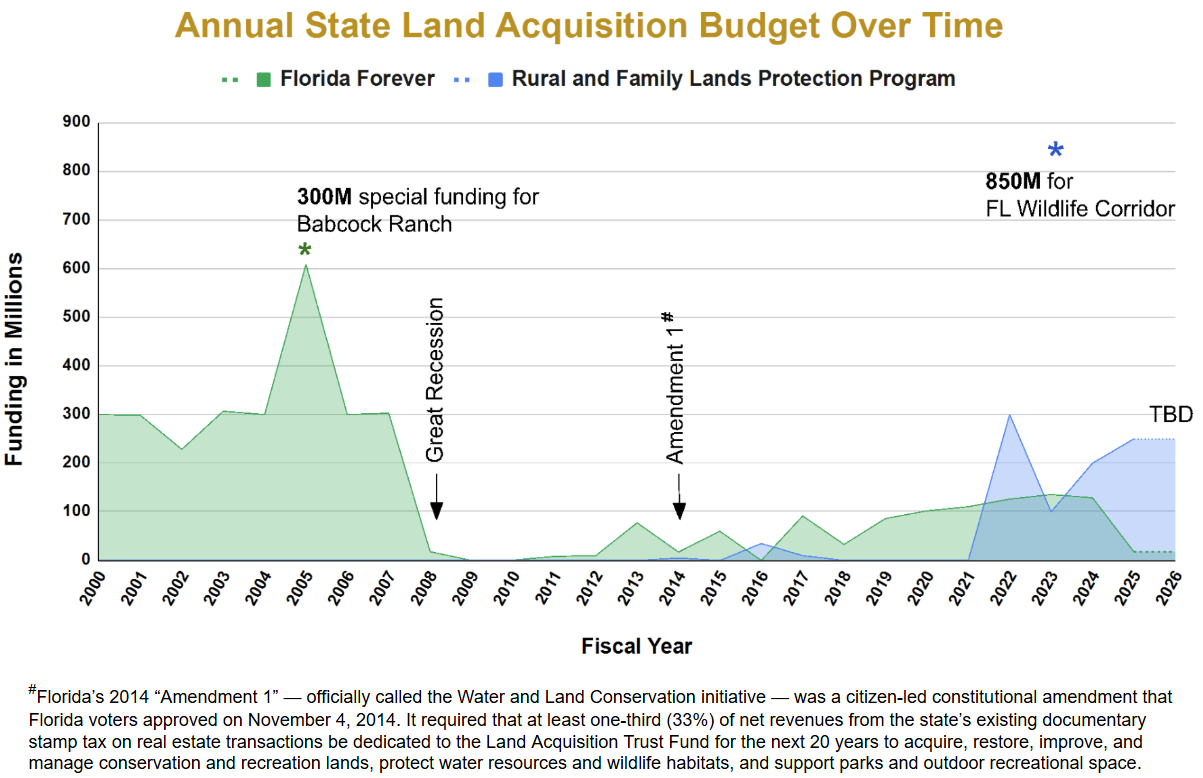
Land conservation is the single most effective mechanism for conserving native plants, and we have supported generous funding for the Florida Forever program since its inception 25 years ago. The Florida Legislature’s 2025–2026 budget allocated only $18 million for Florida Forever, just two years after it passed legislation requiring a minimum allocation of $100 million annually—which is still only a third of the $300 million that was allocated annually for land conservation from 2000–2008. In contrast, $250 million was allocated for the Rural and Family Lands Protection Program (RFLPP), which protects agricultural land by purchasing easements designed to keep those lands in agricultural production. FNPS supports RFLPP as a complement to Florida Forever because agricultural lands can sometimes play a role in plant conservation, environmental protection, and filling gaps in the Florida Wildlife Corridor; however, Florida Forever is the more important program, and we believe the current funding formula should be reversed, with Florida Forever receiving a much larger share of funding than RFLPP.
- Florida Forever land purchases prioritize the protection of habitat for native plants and wildlife, conservation of water resources and cultural sites, and environmental protection while accommodating compatible recreational use by the public.
- Florida Forever can also purchase perpetual conservation easements that allow the protected land to remain in private ownership and use while requiring natural areas to be retained and limiting the landowner’s ability to convert “working lands” with habitat value (e.g., rangeland and pine plantation) to more intensive uses.
- RFLPP prioritizes keeping agricultural lands in production, and easements purchased through the program rarely prevent natural lands or areas in low-intensity agricultural uses from being converted to more intensive agricultural uses (e.g., row crops) and do not include any provisions for public recreational use.
- The share of real estate excise taxes collected by the state and required to be deposited into the Land Acquisition Trust Fund last year exceeded $1 billion and is expected to exceed $1 billion again this year—meaning Florida can easily afford to dedicate MUCH MORE funding to land conservation.
- The rapid pace of land development consuming Florida’s remaining natural areas demands the state respond with a greater sense of urgency to conserve the most important and sensitive lands before they are converted into subdivisions, strip malls, and industrial parks.
- FNPS is requesting a minimum allocation of $300 million for Florida Forever during the 2026 legislative session.
CURRENT STATUS: Funding now proposed for Florida Forever falls far below $300 million and is exceeded greatly by the funding proposed for RFLPP.
2) Support legislation and funding to restore the Ocklawaha River
It is way past time for Florida to finally restore a free-flowing Ocklawaha River by breaching the Kirkpatrick Dam and draining the Rodman Reservoir. The dam and reservoir, which are relics of the 1960s Cross Florida Barge Canal boondoggle, impounded the Ocklawaha River and flooded 7,500 acres of naturally forested floodplain. The plan was halted by President Nixon in 1971 based on a host of environmental concerns. The obsolete dam now needs major repairs to prevent future failure and serves no constructive use beyond continuing to impound water and maintain a degraded reservoir. Restoration of the Ocklawaha would be one of the simplest, most cost-effective, and impactful large-scale environmental restoration projects ever conducted, and FNPS will work with our partners in the Reunite the Rivers Coalition to promote legislation that would initiate and fund restoration.
- More than 7,500 acres of forested floodplain wetland and a 16-mile length of natural Ocklawaha River channel would be restored by draining the reservoir.
- Breaching the dam would resuscitate up to 20 springs and spring run streams that were drowned by the reservoir and dam.
- It is estimated that 150 million gallons of additional river flow per day would be restored to the St. Johns River, helping restore health to a large area of submerged aquatic plant communities degraded by pollution of the St. Johns and impeding saltwater intrusion now resulting from sea level rise.
- Manatees would regain unrestricted access to the entire Ocklawaha system, including the warm-water refuges provided by the resuscitated springs, and Atlantic sturgeon, striped bass, and American shad would regain spawning habitat denied to them by the dam since 1968.
- The open-water expanse of the reservoir serves as a major barrier to plant and animal movement through a critical segment of the Florida Wildlife Corridor.
- Opportunities for recreational use would expand with restoration, and development of recreational amenities to benefit the local economy is an important component of the proposed restoration plan.
CURRENT STATUS: SB 1066 (Brodeur) and HB 981 (Duggan), entitled Tributaries of the St Johns River, meet FNPS objectives for Ocklawaha Restoration. Both were passed during initial committee reviews. Future action may be required to counter objections.
3) Protect conservation easements from improper extinguishment
Conservation easements are increasingly used as a tool for conserving land. Section 704.06 of the Florida Statutes establishes that conservation easements are perpetual legal instruments that remain in place following any future sale of the protected property. It also allows the holder of a conservation easement to release it and thereby extinguish the restrictions on use of the land imposed by the easement. FNPS believes it is important to have a process in place that prohibits a conservation easement from being extinguished unless it can no longer provide the intended conservation benefit. No such process has been codified in statute. FNPS will work with the Legislature and our conservation partners to rectify this shortcoming. A judicial review should be required to determine whether the conservation benefit(s) that served as the basis for the original purchase of an easement can no longer be met.
- Most current Florida Forever and RFLPP easements prohibit extinguishment unless a court of competent jurisdiction determines the easement purposes can no longer be accomplished and establishes that changes in the use of adjoining lands cannot serve as justification for extinguishment.
- Section 704.06, F.S., should be amended to codify a requirement for the judicial process described above.
- Extinguishment of an easement that can no longer achieve the intended conservation benefit should require reimbursement of the fair market value of the easement to the public or institutional holder of the easement and require that the reimbursed funds be reinvested in conservation elsewhere.
CURRENT STATUS: SB 938 (McClain) and HB 673 (Duggan), entitled Conservation Easements, conflicts with FNPS objectives by making it easier to extinguish easements held by water management districts. Neither has been scheduled for committee hearings. FNPS is pursuing our objective by coordinating to amend another bill we support.
4) Increase funding for Threatened & Endangered Native Flora Conservation Grants
The Legislature created the Endangered and Threatened Native Flora Conservation Grants Program in 1997 to support the “protection, curation, propagation, and monitoring of native plant species that are listed by the state as Endangered or Threatened.” The program is administered by the Florida Department of Agriculture and Consumer Services (FDACS) and is contingent upon receiving an annual appropriation from the Legislature. Funding reached a high of $250,000 in fiscal year 2005–2006 and has declined progressively to the current level of $216,000 for 2024–2025. As grant funding has declined, the threats facing these species have only increased in severity. FNPS will pursue an increase in the level of funding for these grants.
- FDACS currently lists 447 of Florida’s native plant species as Endangered and an additional 118 species as Threatened (total = 565), which accounts for more than 12 percent of all plant species native to Florida.
- A large percentage of Florida’s T&E plant species are “endemic,” meaning they occur nowhere else on Earth except Florida.
- The research and conservation projects supported by the grants often serve as a magnet that attracts matching funds from other sources and induces additional investment that advances the state’s plant conservation efforts.
- Habitat restoration and management actions funded by the grants also benefit some of Florida’s most imperiled wildlife species, including the Florida panther, Florida scrub jay, Eastern indigo snake, and Florida grasshopper sparrow.
- Conservation of many imperiled wildlife species is supported by funding levels that far exceed the $216,000 allocated last year to support the conservation of all the state’s imperiled plant species. FNPS does not suggest funding for conservation of imperiled wildlife should be reduced; however, funding for plant conservation is far short of the level required to be effective.
CURRENT STATUS: Ensuring a line item for this funding is included in the budget cannot be completed until late in the session. FNPS consistently tracks and promotes inclusion of the funding for these grants.
5) Push for the repeal or amendment of sections of Senate Bill 180 (Emergencies)
Senate Bill 180, entitled Emergencies, was originally intended to streamline hurricane recovery efforts. Late in the 2025 legislative session, prior to its passage, the bill was amended in ways that greatly exceeded its original intent. Sections 18 and 28 of the bill included provisions that prohibit local governments from proposing or adopting amendments to comprehensive plans or land development regulations that would be “more restrictive or burdensome” than those in place prior to a hurricane strike, even if they are unrelated to hurricane recovery. The result has severely curtailed the ability of local governments to exercise any meaningful control over land use and development decision-making. Rules that limit development in rural areas to prevent sprawl, help protect natural areas, or prevent impacts to wetlands are all negated if a developer claims they are more burdensome. FNPS will work with the Legislature and coordinate with our partners in conservation to ensure the offending provisions are repealed or amended.
- The law is retroactive to August 1, 2024, so land use and development restrictions passed at any time since then are invalidated if they are “more restrictive or burdensome” than preexisting regulations, without defining how “restrictive” or “burdensome” are measured.
- The land area under the jurisdiction of the law was defined very broadly to include the entirety of any county or city located within 100 miles of the area directly in the path of a hurricane, meaning the entire state of Florida is governed by the law’s restrictions owing to the combined strikes by Hurricanes Debbie, Helene, and Milton.
- At the time this priority list was developed, at least 20 local governments had filed suit challenging the law due to its impact on their land use authority and ability to enforce land use restrictions that were approved long before the hurricanes.
CURRENT STATUS: SB 840 (DiCeglie) and HB 1465 (Andrade) appear to effectively address the offending provisions of SB 180 passed in 2025. Approved in Senate by 2 of the 3 committees assigned to review. No action yet in House.
6) Support passage of Nature Based Solutions for Improving Coastal Resilience.
Senate Bill 302 (Garcia) and House Bill 1035 (Mooney) would require FDEP to establish standards and design guidelines for “green infrastructure” and other nature-based methods to protect coastal areas from the impacts of sea level rise and storm-induced erosion and to promote the restoration of mangrove forests to stabilize the coastline. Similar legislation failed to pass last year. FNPS promoted reintroduction of the bill and will again support its passage.
CURRENT STATUS: SB 302 passed the Senate Environment and Natural Resource Committee on Dec 2 and remains to be reviewed by both the Appropriations Committee on Agriculture, the Environment and General Government, and by Fiscal Policy. The House bill has not yet been scheduled for review by any of the 3 committees to which it was referred. Action may be required to promote movement in the House.
Compendium of Legislative Bills of Interest to FNPS
Updated January 2026
The following is a list of bills that FNPS is tracking. It is not necessarily all-inclusive. Some of the bills have been assigned a higher level of priority than others. The relevance of some to native plant conservation may be indirect or ancillary. Several continue an ongoing attack by the Legislature on the authority of local governments to manage growth.
SB 150 (Rodriguez) and HB 11 (Mooney): Designation of the State Birds
Designates American flamingo as official state bird and the Florida scrub-jay as the official state songbird; provides that such designation supersedes designation of mockingbird as official Florida state bird.
CURRENT STATUS: Passed 1st Senate Comm and 2 of 3 House Comms
_____
SB 208 (McClain) and HB 399 (Borrero): Land Use and Development Regulations
Would facilitate residential development by making the development permit and development order application process less costly and also make it harder for local governments to deny applications due to a lack of compatibility by requiring specific reasons for such denial. Would apply to single-family or two-family dwellings.
CURRENT STATUS: Passed by both Senate Community Affairs and Judiciary; still to be acted on by Rules. In House, referred to Intergovernmental Affairs Subcommittee; then to be scheduled for State Affairs Comm and Intergovernmental Affairs Subcomm; not yet reviewed in the House.
_____
SB 218 (Gaetz & Trumbull) and HB 217 (Abbott) Land Use Regulations
An act relating to land use regulations; amending definition of “impacted local government” as used in SB 180 passed in 2025 This legislation appears to do nothing more than provide a slightly more narrow definition of the local governments encompassed by SB 180 and it entirely ineffectual as a “fix” for the objectionable elements of SB 180.
CURRENT STATUS: Not yet scheduled for any hearings in either the House or Senate.
From FL Audubon Legislative Summary (December 2025):
“SB 218/HB 217 appears on the surface to be a remedy to last year’s SB 180 which forbids local governments from strengthening any land use provision until 2027; however it still maintains restrictions on most of the state (other than the western Panhandle and Dade and Monroe counties) limiting local governments’ ability to adopt growth-management tools that link development approvals to infrastructure readiness—a cornerstone of responsible planning.”
_____
SB 240 (Garcia) and HB 575 (Weinberger): Auxiliary Containers
Would preempt the regulation of auxiliary containers (single-use plastic, polystyrene, and glass) to the state; require FDEP to develop a uniform ordinance for the use and disposition of such containers; and prohibit the use, sale, or distribution of them in state parks. This is a big step forward from a bill that failed in 2025 and would have preempted the authority of local governments and state parks to restrict auxiliary containers without any requirement for the state to impose restrictions. This bill allows existing local government regulations to remain, requires FDEP to act to rein in the use of such packaging, and would apply restrictions to all state parks. The FNPS Governmental Affairs Advisor assisted in the advancement of this legislation, and it is strongly supported by FNPS and many of our conservation partners to reduce pollution of our waterways.
CURRENT STATUS:
Passed by Senate Env & Nat Res Comm; not yet heard by Approps Comm on Ag, Env & General Gov or by Fiscal Policy. Not scheduled yet in the House.
_____
SB 290 (Truenow) and HB 433 (Alvarez): Department of Agriculture and Consumer Services
This lengthy 71-page bill includes provisions that would prohibit local governments from enacting any law that restricts or prohibits the use of gasoline-powered farm equipment or landscape equipment (e.g., leaf blowers) and, more problematically, would require the Acquisition and Restoration Council to determine whether certain lands protected under Florida Forever could be declared surplus and made available for “bona fide agricultural purposes.” The latter provision would open the door for conserved lands to be surrendered for agricultural use, with the proceeds generated by any subsequent sale going to fund RFLPP purchases. In effect, Florida Forever lands would be liquidated to expand agriculture while providing additional funding to RFLPP. BAD!!!!
CURRENT STATUS: Has passed 2 of 3 Senate committees and 1 of 4 in the House.
_____
SB 354 (McClain) and HB 229 (Melo): Blue Ribbon Projects
Creates a framework that would preempt local government comprehensive planning and land use regulations for large-scale development projects (Blue Ribbon Projects) in exchange for a certain amount of “reserve area.” Such projects must include at least 10,000 acres of land, with at least 60 percent reserved for uses such as environmental protection, agriculture, recreation, and utilities sites, while the remainder may be developed over 50 years into towns and cities regardless of underlying comprehensive planning and land use allocations. Blue Ribbon Projects could be located on land with any future land use designation or zoning designation.
Excerpted from Seeking Rents: Records show that executives at Ruane Cunniff—a Manhattan-based firm that manages hedge funds, mutual funds, and other investment vehicles—are behind an obscure entity pushing bills in the Florida Legislature this year that would enable giant landowners to have their properties rezoned for high-intensity development without a local public hearing or vote in the communities where the projects would occur.
The Ruane Cunniff-backed company has hired nearly 20 lobbyists in Tallahassee who have been quietly meeting with lawmakers in support of the legislation—which, if passed, could dramatically boost the value of the vast land holdings the firm has assembled in Florida over the past decade. Separate records show that another corporate entity controlled by Ruane Cunniff executives recently began making campaign contributions to key figures in the Florida Capitol. That entity has made more than $150,000 in campaign contributions in the two months since House Bill 299 and Senate Bill 354 were filed in the Legislature, including $10,000 apiece for each of the bill sponsors. Supporters have dubbed it the “blue ribbon projects” bill and are selling it as a way to promote smart growth by dangling the prospect of automatic development entitlements in front of landowners who agree to set parts of their property aside for conservation.
CURRENT STATUS: Passed by 2 of 3 committees in the Senate and first of 3 House committees.
_____
SB 508 (Truenow) and HB 611 (Cobb): Landscape Irrigation
The “Landscape Irrigation Standards and Watering Restrictions Act” would prohibit actions regarding a landscape irrigation system unless performed by a licensed irrigation contractor or the property owner; specify that only a licensed contractor may connect an irrigation system to a water supply; and create a landscape irrigation watering schedule. This legislation purports to recognize a need for water conservation. It has not been scheduled for a hearing in either the Senate or the House, and a legislative analysis has not been completed.
SB 544 (Truenow) and HB 495 (Albert): Golf Courses/BMP Certification
The “Golf Course Best Management Practices Certification Act” would establish that the management of golf course turf is an agricultural act and thereby transfer golf course BMP certification and oversight authority from FDEP to FDACS based on the “foundational agricultural nature” of golf courses. How is management of golf course turf agricultural, but not the turf on playing fields? This legislation would likely increase the water quality degradation impacts of golf courses and is opposed by FNPS.
CURRENT STATUS: These bills have passed initial committee reviews in both the Senate and the House.
_____
SB 546 (Mayfield) and HB 441 (Kendall): Conservation Lands
Would require the Division of State Lands and water management districts to provide 30 days’ notice before any meeting to review the proposed sale or exchange of conservation lands; require the notice to contain information about the parcels proposed for sale or exchange and the portions of land that would be preserved in a conservation easement; and include a statement explaining why the lands are no longer needed for conservation purposes or how the exchange will result in a net conservation benefit to the state. The bill also requires that parcels proposed for exchange have at least one appraisal that follows board-approved appraisal criteria, techniques, and methods. This bill was filed to address public outrage over surreptitious attempts by the Governor and FDEP last year to sell or “swap” protected conservation lands, including parts of the Guana River Wildlife Management Area and the Withlacoochee State Forest. FNPS and our conservation partners strongly support this legislation.
CURRENT STATUS:
The House bill has passed all committees and is ready for a floor vote. The Senate bill has be passed by 2 of 3 committees.
_____
SB 602 (Bernard) and HB 545 (Gerwig): Watercraft Restrictions Based on Energy Source
Does this preempt the authority of state agencies and local governments to restrict the use or sale of watercraft based on the energy source (electric or gasoline) used to power the watercraft on certain bodies of water? It appears to simply exempt restrictions on lakes and artificial waterbodies if done to prevent contamination.
_____
SB 686 (McClain) and HB 691 (Botana): Agricultural Enclaves
Authorizes owners of parcels greater than 10,000 acres to apply to local governments to certify such parcels as agricultural enclaves; provides exemptions to the local government’s land use authority over future development within the enclave; prohibits local governments from enacting or enforcing certain laws or regulations; and requires local governments to provide a report within a specified timeframe.
CURRENT STATUS: Passed first committee review in both House and Senate.
_____
SB 698 (Martin) and HB 589 (Nix): Onsite Sewage Treatment and Disposal System Permits
Provides that, for a single-family residence that requires the use of an onsite sewage treatment and disposal system (OSTDS), a municipality or political subdivision of the state may not require the owner or builder to obtain a construction permit for the OSTDS as a condition of issuing a building or plumbing permit, thereby prohibiting a municipality or political subdivision from requiring owners and builders of certain residences to receive construction permits from the Department of Environmental Protection as a condition of issuing building or plumbing permits.
CURRENT STATUS:
Each bill has been approved in its initial committee review.
_____
SB 718 (McClain) and HB 479 (Maggard): Land and Water Management
Would prohibit local governments from adopting laws, regulations, rules, or policies relating to water quality or quantity, pollution prevention, or wetlands protection and would preempt such authority to the state; also repeals provisions related to land management review teams created for water management districts. A similar bill was filed by Rep. Maggard in 2024 and did not receive a hearing. This bill is no more deserving of action than its predecessor. FNPS strongly opposes this legislation.
CURRENT STATUS: Neither of these bills has yet been scheduled for a hearing.
_____
SB 766 (Martin) and HB 629 (Esposito): Waste Management (Auxiliary Containers)
Like SB 240 discussed previously, this bill would preempt the regulation of auxiliary containers to the state; however, unlike SB 240, it would not require FDEP to adopt a uniform ordinance. It would authorize rules restricting the use of glass containers at public beaches or state parks, so it is not quite as bad as the bill sponsored by Senator Martin and opposed by FNPS last year. FNPS opposes these bills and supports SB 240 and HB 575. It is noteworthy that HB 575 sponsor Rep. Weinberger killed her own bill last year after the bad provisions of Martin’s bill were added as an amendment to help move it toward passage and is now supporting strong legislation to reduce plastic pollution of our waterways. Special kudos to Rep. Meg Weinberger!
CURRENT STATUS:
Neither of these bills has yet been scheduled for a hearing.
_____
SB 840 (DiCeglie) and HB 1465 (Andrade): Local Governments Affected by Natural Disasters
Prohibits impacted local governments from enforcing certain moratoriums; enforces changes to specified procedures; revises circumstances under which impacted local governments may enforce certain amendments, site plans, development permits, or development orders; and deletes provisions related to suing an impacted local government for injunctive relief.
CURRENT STATUS:
Appears to effectively address the offending provisions of SB 180 passed in 2025. Approved by two of the three Senate committees assigned to review. No action yet in the House. Action may be required to encourage movement in the House.
_____
SB 938 (McClain) and HB 673 (Duggan): Release of Conservation Easements
Requires water management districts, upon request by the fee title owner of a parcel subject to a conservation easement, to release the conservation easement if it is less than 15 acres in size and bordered on three sides by impervious surfaces; specifies that the released land may be developed consistent with zoning; and requires property owners to assume responsibility for stormwater requirements. This is a nearly identical rehash of a bill from last year. Note: the presence of impervious surfaces on adjoining lands could increase the importance of the protected lands for flood protection, and current practice (RFLPP and Florida Forever easements) states that development on adjoining lands is not a reason to extinguish an easement and may increase the value of conserved land if surrounded by development.
CURRENT STATUS:
Neither of these bills has yet been scheduled for a hearing.
_____
SB 1066 (Brodeur) and HB 981 (Duggan): Tributaries of the St. Johns River
The Northeast Florida Rivers, Springs, and Community Investment Act would require FDEP to hire a project lead to oversee implementation of the act; require development of a plan for restoration of the Ocklawaha River; secure a general permit from FDEP and the SJRWMD; and create the Northeast Florida River and Springs Recreation and Economic Development Advisory Council. FNPS and our conservation partners support this legislation.
CURRENT STATUS:
Passed each of its first committee reviews.
_____
SB 1294 (Bradley) and HB 1245 (Shoaf): Biosolids Management
Prohibits the land application of Class AA biosolids fertilizer and compost products from exceeding the agronomic rate; authorizes bulk Class AA biosolids to be distributed or marketed as fertilizer and land-applied if specified requirements are met; authorizes distribution and marketing of Class AA biosolids compost products as soil amendments if specified requirements are met; and requires UF/IFAS to publish recommended agronomic rates for the reuse of Class AA biosolids fertilizer and compost products.
Referred to Senate Environment and Natural Resources; Appropriations Committee on Agriculture, Environment, and General Government; and Rules.
_____
SB 1386 (Smith): Implementation of the Recommendations of the Blue-Green Algae Task Force
Would require owners of onsite sewage treatment and disposal systems (septic systems) to have the systems periodically inspected; require FDEP to administer the inspection program and implement program standards, procedures, and requirements; require that pollutant load reductions in basin management action plans meet or exceed certain total maximum daily load requirements; and revise requirements for the allocation of pollutant load reductions in such plans. The Governor established the Blue-Green Algae Task Force as one of his first acts as Governor, but no action has ever been taken to actually implement the recommendations of the Task Force. This legislation would finally implement one facet of its well-founded, science-based recommendations.
CURRENT STATUS: No House companion; not scheduled by any committee reviews.
_____
SB 1444 (Martin) and HB 1227 (Oliver): Preemption to the State
Would preempt all matters relating to the regulation of religious services and gatherings; prohibit local governments from substantially burdening the free exercise of religion by adopting or enforcing ordinances and other policies; prohibit a local enforcement agency from denying a certificate of occupancy to an owner of a residential or commercial building based on noncompliance with Florida-friendly landscaping ordinances if the owner was issued the building permit for the structure within 1 year after the declaration of a state of emergency for a natural disaster for the county where the structure is located.
CURRENT STATUS: Passed by Senate’s Community Affairs Committee.
_____
SB 1510 (Massullo) and HB 1417 (LaMarka): Department of Environmental Protection
Requires that residential properties of a specified size located in certain areas connect to a central sewer system or upgrade to a specified type of nutrient-reducing septic system; provides that remediation plans for certain properties may not prohibit or require certain actions relating to septic systems; and provides for a transfer of powers and functions from the Florida Communities Trust to the Acquisition and Restoration Council.
CURRENT STATUS: Passed by 2 committees in House and 1 in the Senate.
_____
SB 1628 (Avila) & HB 1217 (Snyder & Jacques): Net-zero Policies by Governmental Entities
Would prohibit local governments from adopting net-zero policies through any policy or procedure, or expending funds to advance net-zero policies through procurement preferences (vehicle purchasing decisions based solely on the fuel source, or payment of dues to organizations that support net-zero policies). Defines “net-zero policy” to include any target, threshold, action, initiative, framework, requirement, or policy related to reducing the use of carbon-intensive products or activities, including policies related to achieving goals under the Paris Agreement.
CURRENT STATUS: Passed first comm in each chamber, including the Senate Env & Nat Res Comm on 5-3 party line vote.
_____
SB 1658 (Truenow) and HB 1421 (Albert): Cattle Grazing on State Land
Would require land managing agencies to consider feasibility of leasing portions of land to private entities for cattle-grazing when land management plans are being developed or updated; provides requirements for land management plans; requires land managing entities to allow such lands to be leased for such purpose under certain conditions.
CURRENT STATUS: Passed first comm in House and 2 of 3 Senate committees.
