
FNPS Plant Database
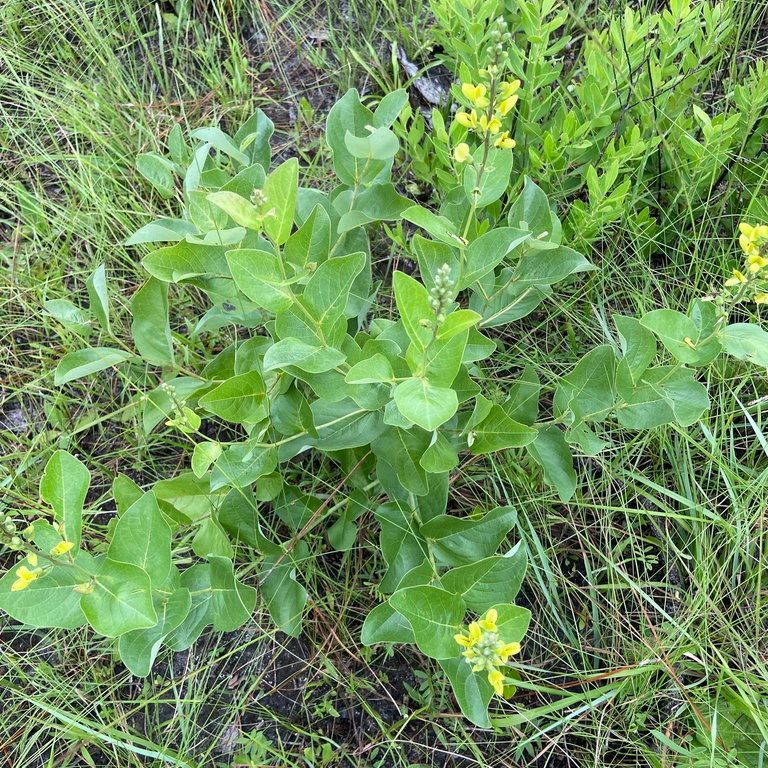
Baptisia simplicifolia
Nomenclature
Common Name:
Synonym(s):
Genus species:
Family:
Fabaceae (Leguminosae)
Plant Specifics
Form:
Size:
Life Span:
Long-lived perennial
Flower Color:
Fruit Color:
Phenology:
Noted For:
Landscaping
Recommended Uses:
Considerations:
Availability:
Propagation:
Light:
Moisture Tolerance:
Always Flooded---------------------------------Extremely Dry
□□□□□□□□□□□□□□□□□□■■■■■■■■■■■■■■■□□□□□□□□□
Somewhat moist, no flooding -to- Short very dry periods
Salt Water Flooding Tolerance:
Unknown
Salt Spray/Salty Soil Tolerance:
Low/no tolerance of salty wind or direct salt spray
Soil or Other Substrate:
Sand, Clay, Loam
Soil pH:
Suitable to Grow In:
8A,8B,9A,9B

USDA zones are based on the average annual extreme minimum winter temperature.
Don't know your zone? Click here to search by zip code.
Ecology
Wildlife:
Larval host for wild indigo duskywing ( Erynnis baptisiae ) and Zarucco duskywing ( Erynnis zarucco ) butterflies.
Pollinated by bumble bees.
Deer and rabbits browse the foliage, and as a legume it provides nutritious, protein-rich food.
Native Habitats:
Comments:
Ethnobotany:
General Comments:
This plant is a legume and its roots have nitrogen-fixing nodules on them. It is useful on nutrient poor soils.
Baptisia simplicifolia is a Florida endemic and is listed as Threatened by the FDACS.


Citations:
Anderson, M.J., D.F. Kurtycz, and J.R. Cline. (2015). Baptisia poisoning: a new and toxic look-alike in the neighborhood. The Journal of emergency medicine, 48(1), 39–42. ( https://doi.org/10.1016/j.jemermed.2014.09.037. Accessed 2025.
Coile, N. and M. Garland. (2010). Notes on Florida's Endangered and Threatened Plants. https://ccmedia.fdacs.gov/content/download/25089/file/notes-on-floridas-endangered-and-threatened-plants.pdf. Florida Dept. of Agriculture and Consumer Services, Tallahassee.
Nelson, Gil. (2005). East Gulf Coastal Plain Wildflowers. Falcon Guides, Guilford, CT.
Taylor, Walter K. (2013). Florida Wildflowers: A Comprehensive Guide. University Press of Florida, Gainesville.
Wunderlin, R. P., B. F. Hansen, A. R. Franck, and F. B. Essig. (1999+). Atlas of Florida Plants. ( https://florida.plantatlas.usf.edu/ ). [S. M. Landry and K. N. Campbell (application development), USF Water Institute.] Institute for Systematic Botany, University of South Florida, Tampa.

