

State Parks Preservation Act passes its first committee stop
Valerie Anderson • February 13, 2025
Share Our Content With Your Friends
RECENT ARTICLES
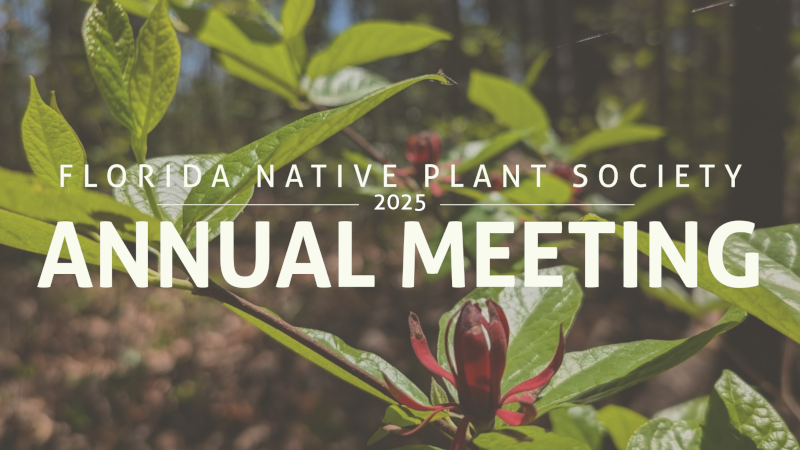
Saturday, July 26th 10am-12pm The Florida Native Plant Society holds a members meeting once a year. All FNPS members are invited to participate. We provide a year in review and announce grant awards, Palmetto Awards for members and vote on new officers. A link to register has been emailed to all members. Please contact us if you are a member in good standing and have not received a link (info@fnps.org & 321-271-6702) AgendaOPENING REMARKS Introduction by President Eugene KellyOLD BUSINESS Approve the 2024 Annual Member Meeting MinutesNEW BUSINESS Introduction of New FNPS Executive Director (Eugene Kelly)Remarks from the Executive Director (Melissa Fernandez de-Cespedes)Update on the Council of Chapters (Past-Chair: Melanie Simon)COMMITTEE REPORTSConservation Committee (Chair: John Benton)Science Committee and Research Grants (Chair: Paul Schmalzer)Finance Committee (Chair: Ann Redmond)Landscape Committee (Chair: Natalia Manrique)Policy & Legislation Committee (Chair: Eugene Kelly)Education Committee (Chair: Andrea Andersen, Presented by Susan Earley)Conference Committee (Chair: Athena Phillips)Announcement of FNPS Awards (Melissa Fernandez de-Cespedes)Silver Palmetto Awards (Eugene Kelly)VOTE FOR FNPS OFFICERS AND BOARD OF DIRECTORSOverview of FNPS Board Nominees and membership vote (Chair: Chris Moran)Motion to adjourn (Eugene Kelly)2024 MinutesReview them here.
On Monday seventy-three businesses and organizations, including the Florida Native Plant Society, representing every corner of the state sent a letter urging Florida legislators to prioritize certain conservation land acquisition, water quality protection, and resiliency funding during the 2025 legislative session that began Tuesday.We have eight major asks:$500M to Florida ForeverSeparate funding for the Rural & Family Lands Program$30M to the Florida Communities TrustProper supplemental use of Indian Gaming Compact $$$Everglades Restoration$150M for springs restorationCease funding coastal armoring & instead fund Resilient FloridaRepair soon-to-fail wastewater infrastructureRead the full letter here.
Hurricanes Melton and Helene brough flooding and wind damage to the human communities in their paths, but they also damaged urban forests. Florida's urban forests have already been weakened by the 2019 state-level preemption of local tree ordinances and research has shown that cities are already losing tree canopy.Urban forests comprised of native trees support local butterfly and moth populations, intercept and take up rainfall which reduces flooding, and improves the quality of life of residents.Homeowners, county and city staff, HOA board members, local politicians, and FNPS members in urban and suburban areas can all help to restore or even establish their local urban forest canopy.The first step is to assess hurricane damaged trees and decide whether or not they can be saved, and, if so, how to do so. This IFAS book chapter describes the recommended process. If trees must be removed, or if the tree canopy has already been damaged and needs to be re-established, this IFAS book chapter describes the many considerations one must take into account when planting trees in urban and suburban areas.Fortunately, researchers have assessed which trees are the least wind resistant with data from eight hurricanes striking Florida and Puerto Rico. The commonly-planted Laurel Oak (Quercus hemispherica) and Red Maple (Acer rubrum) were some of the most-damaged during these wind events. The same study provides rankings for wind resistance of our native species.

