


Florida's Native Plant Communities
Coastal Rock Barren
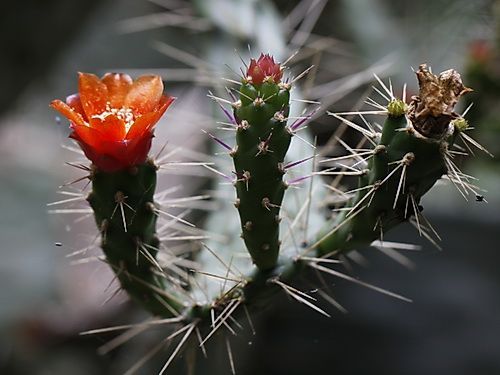
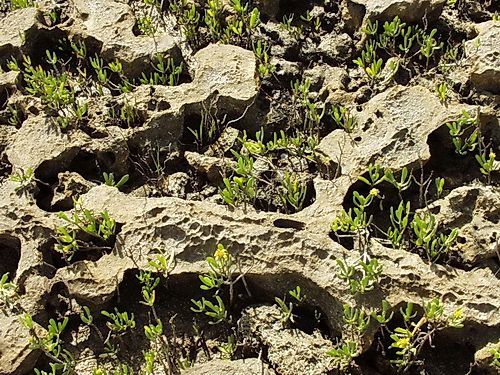
Photographs belong to the photographers who allow use for FNPS purposes only.
Information
Community Variants:
Keys Tidal Rock Barren
Description:
The most common coastal rock barren is found in the Florida Keys, where it is referred to by FNAI as Keys Tidal Rock Barren. Similar systems also occur farther north along the Gulf Coast near Crystal River, where they share comparable hydrology and substrates but support more temperate vegetation. For this reason, the broader term Coastal Rock Barren is used here to represent all of them.
Setting
Coastal rock barrens occur on limestone substrates and are inundated by salt water only during extreme high tides (Ross et al., 1992).
Vegetation
Herbaceous species: Seaside oxeye daisy ( Borrichia spp. ), perennial glasswort ( Salicornia ambigua ), saltwort ( Batis maritima ), shoregrass ( Distichlis littoralis ), saltgrass ( Distichlis spicata ), seashore dropseed ( Sporobolus virginicus ), and marsh fimbry ( Fimbristylis spadicea ).
Woody species (Florida Keys): Buttonwood ( Conocarpus erectus ) is dominant, with red mangrove ( Rhizophora mangle ), black mangrove ( Avicennia germinans ), white mangrove ( Laguncularia racemosa ), and Christmasberry ( Lycium carolinianum ).
Northern variants: Typically lack mangroves or include them in much lower abundance.
Rare Species (Florida Keys)
- Joewood ( Jacquinia keyensis )
- Florida semaphore cactus ( Opuntia corallicola )
Example Locations
- Big Pine Key (The Nature Conservancy preserve)
- Little Torch Key (The Nature Conservancy preserve)
- Ozello area (Gulf Coast, Citrus County)
References:
Florida Department of Environmental Protection. (1992). Soil and water relationships of Florida's ecological communities. http://www.dep.state.fl.us/water/wetlands/delineation/docs/soil-and-water.pdf
Florida Natural Areas Inventory. (2010). Guide to the natural communities of Florida: 2010 edition. Florida Natural Areas Inventory. http://fnai.org/naturalcommguide.cfm
— For Florida Keys coastal rock barrens: https://www.fnai.org/PDF/NC/Keys_Tidal_Rock_Barren_Final_2010.pdf
Gann, G. D., Bradley, K. A., & Woodmansee, S. W. (2009). Floristic inventory of South Florida database. Institute for Regional Conservation. http://regionalconservation.org/ircs/database/database.asp
Knight, G. R., Oetting, J. B., & Cross, L. (2011). Atlas of Florida's natural heritage: Biodiversity, landscapes, stewardship and opportunities. Institute of Science and Public Affairs, Florida State University.
Myers, R. L., & Ewel, J. J. (Eds.). (1990). Ecosystems of Florida. University of Central Florida Press.
Ross, M. S., O’Brien, J. J., & Flynn, L. J. (1992). Ecological site classification of Florida Keys terrestrial habitats. Biotropica, 24(4), 488–502. https://doi.org/10.2307/2389011
Whitney, E. N., Means, D. B., & Rudloe, A. (2004). Priceless Florida: Natural ecosystems and native species. Pineapple Press.
Click to learn about different Florida plant communities or scroll through the page to see all the wonderful unique diversity to be explored.
