

Florida's Native Plant Communities
Dome Swamp
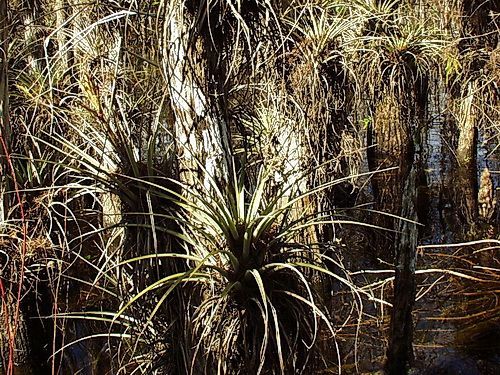
Photographs belong to the photographers who allow use for FNPS purposes only.
Information
Community Variants:
Cypress Dome
Description:
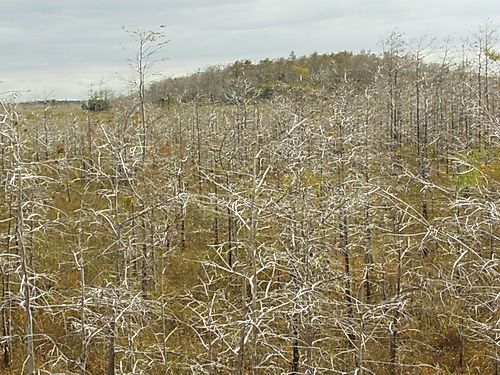
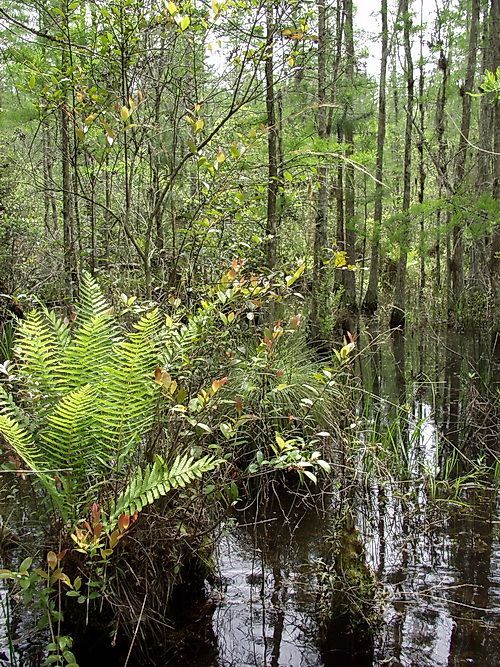
Dome swamps occupy rounded depressions in areas with sandy or limestone substrates, where peat typically accumulates toward the center. They are seasonally inundated still-water systems found in both subtropical and temperate settings. Fire is occasional to rare.
Typical vegetation includes pond cypress ( Taxodium ascendens ) and swamp blackgum ( Nyssa sylvatica var. biflora ) in the center. Toward the margins, in shorter-hydroperiod zones, common species include sweetbay magnolia ( Magnolia virginiana ), loblolly bay ( Gordonia lasianthus ), swamp bay ( Persea palustris ), and swamp laurel oak ( Quercus laurifolia ).
A defining feature of dome swamps is that the tallest trees often occur in the center, while shorter trees dominate the edges. This structure is thought to reflect more frequent fire at the outer margins compared to the wetter, less fire-prone interior.
References:
Florida Department of Environmental Protection. 1992. Soil and Water Relationships of Florida's Ecological Communities http://www.dep.state.fl.us/water/wetlands/delineation/docs/soil-and-water.pdf
Duever, Linda. 1985 (Spring). Florida's Natural Communities: Cypress Swamps. The Palmetto 5, #1:4-5. http://fnps.org/assets/pdf/palmetto/duever_linda_conway_natural_communities_of_floridas_cypress_swamps_vol_5_no_1_spring_1985.pdf
Florida Natural Areas Inventory (FNAI). 2010. Guide to the natural communities of Florida: 2010 edition. Florida Natural Areas Inventory, Tallahassee, FL. http://fnai.org/naturalcommguide.cfm
Gann, G.D., K.A. Bradley, and S.W. Woodmansee. 2009. Floristic Inventory of South Florida Database. Institute for Regional Conservation. http://regionalconservation.org/ircs/database/database.asp
Myers, R.L. and J.J. Ewel (eds.). 1990. Ecosystems of Florida University of Central Florida Press: Orlando.
Simons, R.W. 1990. Terrestrial and freshwater habitats. Pages 99-157 in S.H. Wolfe, editor. An ecological characterization of the Florida Springs Coast: Pithlachascotee to Waccasassa Rivers. Biological Report 90(21). United States Fish and Wildlife Service, Washington, DC.
USDA Soil Conservation Service. 1986. 26 Ecological Communities of Florida. http://ufdc.ufl.edu/UF00000110/00001
Whitney, E.N., D. B. Means, A. Rudloe. 2004. Priceless Florida: Natural Ecosystems and Native Species. Pineapple Press.
Click to learn about different Florida plant communities or scroll through the page to see all the wonderful unique diversity to be explored.
