

Florida's Native Plant Communities
Maritime Hammock
Photographs belong to the photographers who allow use for FNPS purposes only.
Information
Community Variants:
Shell Mound
Description:
Maritime Hammocks
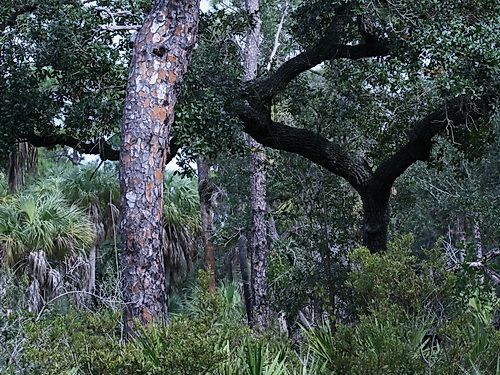
Maritime hammocks occur on raised coastal areas, where the climate is strongly moderated by proximity to the ocean. As a result, they often support vegetation that appears more tropical than that of similar hammocks farther inland. Soils are typically sandy, and fire is rare or absent. The canopy is usually a mixed hardwood forest often dominated by live oak ( Quercus virginiana ).
Shell Mounds
Shell mounds are anthropogenic formations, composed of accumulated shells built by Indigenous peoples along Florida’s coasts. These unique substrates support plant communities that include subtropical species as well as species with a strong affinity for calcium-rich soils. Some plant assemblages also include species with affinities to Central America and the Caribbean.
Two rare Florida plants are closely associated with shell mounds:
- Spiny hackberry (Celtis pallida)– Florida Endangered; may have been introduced from the U.S. Southwest before European contact.
- Sugarberry ( Celtis laevigata ) – Florida Endangered.
References:
Florida Department of Environmental Protection. (1992). Soil and water relationships of Florida's ecological communities. http://www.dep.state.fl.us/water/wetlands/delineation/docs/soil-and-water.pdf
Florida Natural Areas Inventory. (2010). Guide to the natural communities of Florida: 2010 edition. Florida Natural Areas Inventory. http://fnai.org/naturalcommguide.cfm
Gann, G. D., Bradley, K. A., & Woodmansee, S. W. (2009). Floristic inventory of South Florida database. Institute for Regional Conservation. http://regionalconservation.org/ircs/database/database.asp
Knight, G. R., Oetting, J. B., & Cross, L. (2011). Atlas of Florida's natural heritage: Biodiversity, landscapes, stewardship and opportunities. Institute of Science and Public Affairs, Florida State University.
Myers, R. L., & Ewel, J. J. (Eds.). (1990). Ecosystems of Florida. University of Central Florida Press.
U.S. Department of Agriculture, Soil Conservation Service. (1986). 26 ecological communities of Florida. http://ufdc.ufl.edu/UF00000110/00001
Whitney, E. N., Means, D. B., & Rudloe, A. (2004). Priceless Florida: Natural ecosystems and native species. Pineapple Press.
Click to learn about different Florida plant communities or scroll through the page to see all the wonderful unique diversity to be explored.
