


Florida's Native Plant Communities
Mesic Flatwood
Photographs belong to the photographers who allow use for FNPS purposes only.
Information
Community Variants:
N/A
Description:
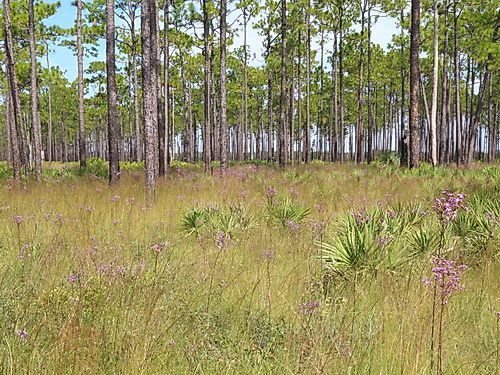
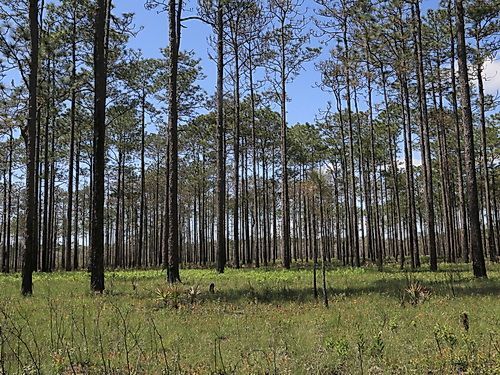
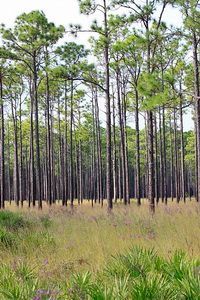
Mesic flatwoods occur in extensive flat landscapes characterized by sandy soils, often underlain by a hardpan at moderate depth. Fire is frequent and plays a critical role in maintaining this community.
Typical vegetation includes a longleaf pine ( Pinus palustris ) overstory—sometimes sparse—above a groundcover dominated by wiregrass ( Aristida stricta ), with little to no woody understory. Dwarf running oaks ( Quercus minima ) are sometimes abundant.
References:
Clewell, A. F. (1986). Natural setting and vegetation of the Florida Panhandle: An account of the environments and plant communities of northern Florida west of the Suwannee River (Report No. COESAM/PDEI-86/001). U.S. Army Corps of Engineers, Mobile District.
Duever, L. (1984–1985, Winter). Florida’s natural communities: Flatwoods. The Palmetto, 4(4), 6. http://fnps.org/assets/pdf/palmetto/duever_linda_conway_natural_communities_of_floridas_flatwoods_vol_4_no_4_winter_1984.pdf
Florida Department of Environmental Protection. (1992). Soil and water relationships of Florida’s ecological communities. http://www.dep.state.fl.us/water/wetlands/delineation/docs/soil-and-water.pdf
Florida Natural Areas Inventory. (2010). Guide to the natural communities of Florida: 2010 edition. Florida Natural Areas Inventory. http://fnai.org/naturalcommguide.cfm
Florida Natural Areas Inventory & Florida Department of Natural Resources. (1990). Guide to the natural communities of Florida. Florida Natural Areas Inventory. http://fnai.org/PDF/Natural_Communities_Guide_1990.pdf
Knight, G. R., Oetting, J. B., & Cross, L. (2011). Atlas of Florida’s natural heritage: Biodiversity, landscapes, stewardship and opportunities. Institute of Science and Public Affairs, Florida State University.
Myers, R. L., & Ewel, J. J. (Eds.). (1990). Ecosystems of Florida. University of Central Florida Press.
Outcalt, K. W. (1997). An old-growth definition for tropical and subtropical forests in Florida (General Technical Report SRS-13). U.S. Department of Agriculture, Forest Service, Southern Research Station.
U.S. Department of Agriculture, Soil Conservation Service. (198-). 26 ecological communities of Florida. http://ufdc.ufl.edu/UF00000110/00001
Whitney, E. N., Means, D. B., & Rudloe, A. (2004). Priceless Florida: Natural ecosystems and native species. Pineapple Press.
Click to learn about different Florida plant communities or scroll through the page to see all the wonderful unique diversity to be explored.
