


Florida's Native Plant Communities
Mesic Hardwood
Photographs belong to the photographers who allow use for FNPS purposes only.
Information
Community Variants:
Slope Forest, Second Bottom
Description:
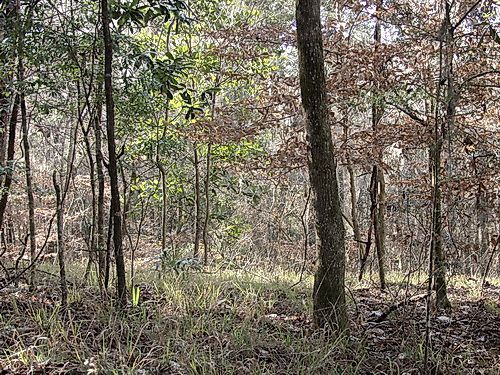
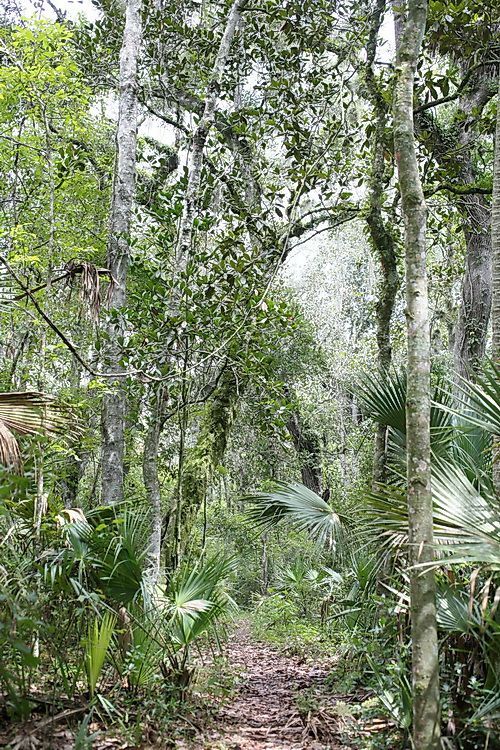
Mesic hammocks are mesic forests typically found on moderate to steep slopes in ravines, uplands adjacent to rivers, and other areas protected from fire. Soils range from sandy to clayey.
The overstory is commonly composed of southern magnolia ( Magnolia grandiflora ), American beech ( Fagus grandifolia ), spruce pine ( Pinus glabra ), Shumard oak ( Quercus shumardii ), Florida maple ( Acer floridanum ), and other hardwoods.
In Florida, mesic hammocks support several rare species, including early spring bloomers that appear before the deciduous trees leaf out. Many of these plants are more typical of communities further north. Examples include trout lily ( Erythronium umbellatum ), bloodroot ( Sanguinaria canadensis ), several trillium species, and columbine ( Aquilegia canadensis ). Flame azalea ( Rhododendron calendulaceum ) also occurs in the Panhandle.
Good places to explore mesic hammock communities include Florida Caverns State Park, Three Rivers State Park, and Apalachicola Bluffs and Ravines Preserve (The Nature Conservancy).
References:
Batista, W. B., & Platt, W. J. (1997). An old-growth definition for southern mixed hardwood forests (General Technical Report SRS-9). U.S. Department of Agriculture, Forest Service, Southern Research Station.
Clewell, A. F. (1986). Natural setting and vegetation of the Florida Panhandle: An account of the environments and plant communities of northern Florida west of the Suwannee River (Report No. COESAM/PDEI-86/001). U.S. Army Corps of Engineers, Mobile District.
Daubenmire, R. (1990). The Magnolia grandiflora–Quercus virginiana forest of Florida. American Midland Naturalist, 123(2), 331–347. https://doi.org/10.2307/2425766
Delcourt, H. R., & Delcourt, P. A. (1977). Presettlement magnolia–beech climax of the Gulf Coastal Plain: Quantitative evidence from the Apalachicola River bluffs, North-Central Florida. Ecology, 58(5), 1085–1093. https://doi.org/10.2307/1936923
Duever, L. (1988, Summer). Florida’s natural communities: Mesic hammock. The Palmetto, 8(2), 4–5. http://fnps.org/assets/pdf/palmetto/v08i2p4duever.pdf
Florida Department of Environmental Protection. (1992). Soil and water relationships of Florida’s ecological communities. http://www.dep.state.fl.us/water/wetlands/delineation/docs/soil-and-water.pdf
Florida Natural Areas Inventory. (2010). Guide to the natural communities of Florida: 2010 edition. Florida Natural Areas Inventory. http://fnai.org/naturalcommguide.cfm
Knight, G. R., Oetting, J. B., & Cross, L. (2011). Atlas of Florida’s natural heritage: Biodiversity, landscapes, stewardship and opportunities. Institute of Science and Public Affairs, Florida State University.
Myers, R. L., & Ewel, J. J. (Eds.). (1990). Ecosystems of Florida. University of Central Florida Press.
Outcalt, K. W. (1997). An old-growth definition for tropical and subtropical forests in Florida (General Technical Report SRS-13). U.S. Department of Agriculture, Forest Service, Southern Research Station.
U.S. Department of Agriculture, Soil Conservation Service. (198-). 26 ecological communities of Florida. http://ufdc.ufl.edu/UF00000110/00001
Whitney, E. N., Means, D. B., & Rudloe, A. (2004). Priceless Florida: Natural ecosystems and native species. Pineapple Press.
Click to learn about different Florida plant communities or scroll through the page to see all the wonderful unique diversity to be explored.
