

Florida's Native Plant Communities
Upland Glade
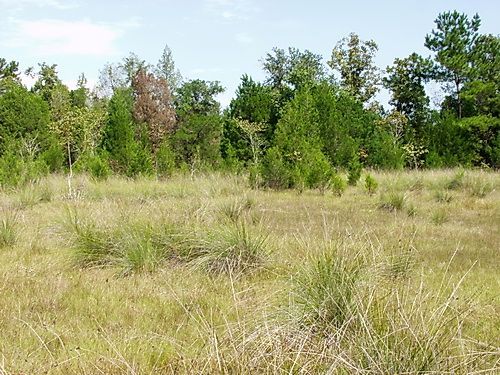
Photographs belong to the photographers who allow use for FNPS purposes only.
Information
Community Variants:
Sandstone Glade
Description:
Upland glades are restricted to North Florida, occurring primarily in the Panhandle. They are extremely rare and occur on thin soils over bedrock substrates. Two distinct types are recognized: limestone glades and a single known sandstone glade. Fire does not play a major role in these communities.
Limestone Glades: Found on limestone with a thin soil covering, often on slopes (some steep). Plant cover is open, partly because the high-pH soils limit species diversity. Most glades are very small, with the largest only about 2 acres, and are surrounded by woodlands with deeper soils. Vegetation is predominantly herbaceous, though patches of trees and shrubs occur around the edges.
Grasses and sedges: Black bogrush ( Schoenus nigricans ), poverty dropseed ( Sporobolus vaginiflorus ), hairawn muhly ( Muhlenbergia capillaris ), little bluestem ( Schizachyrium scoparium ), pineywoods dropseed ( Sporobolus junceus ), spreading beaksedge ( Rhynchospora divergens ).
Other characteristic herbs: Cherokee sedge ( Carex cherokeensis ), lanceleaf tickseed ( Coreopsis lanceolata ), cypress witchgrass ( Dichanthelium dichotomum ), false garlic ( Nothoscordum bivalve ), Boykin’s milkwort ( Polygala boykinii ), starrush whitetop ( Rhynchospora colorata ), diamondflowers ( Stenaria spp. ), Gulf spike-moss ( Selaginella arenicola ).
Trees and shrubs: These occcur mostly at the edges and include red cedar ( Juniperus virginiana ), eastern redbud ( Cercis canadensis ), sugarberry ( Celtis laevigata ), roughleaf dogwood ( Cornus drummondii ), white ash ( Fraxinus americana ), yaupon holly (Ilex vomitoria), winged elm ( Ulmus alata ).
Sandstone Glade: Distinguished by a sandstone substrate. Only a single occurrence is known in Florida, located within a The Nature Conservancy preserve.
Special Features / Rare Species
Limestone glades host a suite of rare plants, including:
- Littletooth sedge ( Carex microdonta )
- Green milkweed ( Asclepias viridiflora )
- Poppy mallow ( Callirhoe papaver )
- Carolina larkspur ( Delphinium carolinianum )
- Shootingstar ( Dodecatheon meadia )
- Eastern purple coneflower ( Echinacea purpurea )
- Little-people ( Lepuropetalon spathulatum )
- Pinnate-lobed coneflower ( Rudbeckia triloba )
- Shade betony ( Stachys crenata )
Several other species occur in Florida only in limestone glades, though they are not formally listed as rare (FNAI, 2010).
Example Locations
Upland glades are both rare and difficult to access, as nearly all sites are on private lands. The few located on public lands are very small and not widely publicized in order to protect the fragile plant communities.
References:
Clewell, A. F. (1986). Natural setting and vegetation of the Florida Panhandle: An account of the environments and plant communities of northern Florida west of the Suwannee River (Report No. COESAM/PDEI-86/001). U.S. Army Corps of Engineers, Mobile District.
Duever, L. (1984–1985, Winter). Florida’s natural communities: Flatwoods. The Palmetto, 4(4), 6. http://fnps.org/assets/pdf/palmetto/duever_linda_conway_natural_communities_of_floridas_flatwoods_vol_4_no_4_winter_1984.pdf
Florida Department of Environmental Protection. (1992). Soil and water relationships of Florida's ecological communities. http://www.dep.state.fl.us/water/wetlands/delineation/docs/soil-and-water.pdf
Florida Natural Areas Inventory. (2010). Guide to the natural communities of Florida: 2010 edition. Florida Natural Areas Inventory. http://fnai.org/naturalcommguide.cfm
Knight, G. R., Oetting, J. B., & Cross, L. (2011). Atlas of Florida's natural heritage: Biodiversity, landscapes, stewardship and opportunities. Institute of Science and Public Affairs, Florida State University.
Noss, R. F. (2013). Forgotten grasslands of the South: Natural history and conservation. Island Press.
Whitney, E. N., Means, D. B., & Rudloe, A. (2004). Priceless Florida: Natural ecosystems and native species. Pineapple Press.
Click to learn about different Florida plant communities or scroll through the page to see all the wonderful unique diversity to be explored.
