

Florida's Native Plant Communities
Wet Flatwood
Photographs belong to the photographers who allow use for FNPS purposes only.
Information
Community Variants:
N/A
Description:
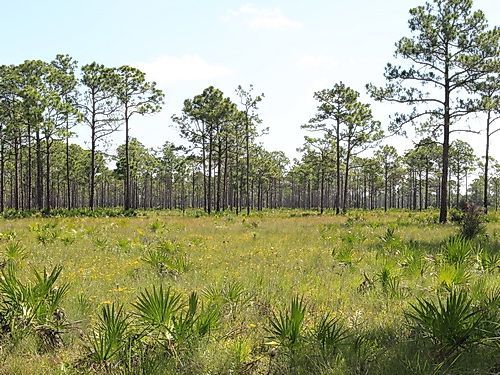
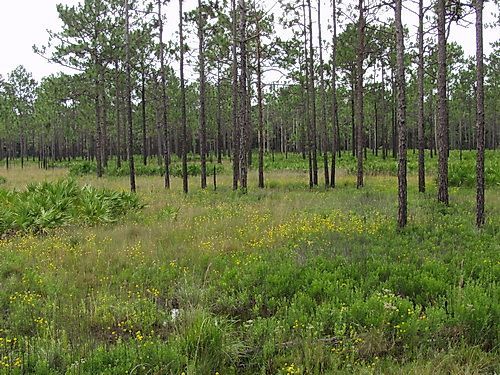
Wet flatwoods occur in extensive, poorly drained flat areas that may be inundated during periods of high rainfall. They are found in both subtropical regions and areas with a peninsular climate. Fire is frequent. Vegetation is typically characterized by an overstory of slash pine ( Pinus elliottii ), pond pine ( Pinus serotina ), and/or cabbage palm ( Sabal palmetto ), with a groundcover of mixed grasses and herbs.
This habitat functions seasonally as both wetland and upland. The predictable nature of these hydrologic shifts supports an abundant diversity of plant life, including both wetland and upland annuals. By alternating between wetland and upland conditions, wet flatwoods allow species from both systems to utilize the same habitat through temporal displacement. The broad latitudinal range of hydric pine flatwoods creates diverse microclimates: in the south, tropical floral components dominate, while in the north and frost-prone interior, the understory is largely temperate. This variation contributes to high species diversity in the ground layer.
As a result, wet pine flatwoods support the highest plant species diversity of any habitat in southern Florida. More than 900 plant species are documented, including over 80 that are endemic to Florida or considered rare (USFWS, 1999).
High-quality wet flatwoods can be found in:
- Big Cypress National Preserve (Collier County)
- Babcock-Webb Wildlife Management Area
- Charlotte Harbor Buffer Preserve State Park
- Collier-Seminole State Park
- CREW (Corkscrew Regional Ecosystem Watershed)
- Fakahatchee Strand Preserve State Park
- Florida Panther National Wildlife Refuge
- Jonathan Dickinson State Park
- Green Swamp (Southwest Florida Water Management District lands)
References:
Duever, M. J., Carlson, J. E., Meeder, J. F., Duever, L. C., Gunderson, L. H., Riopelle, L. A., Alexander, T. R., Myers, R. L., & Spangler, D. P. (1986). The Big Cypress National Preserve (Research Report 8). National Audubon Society.
Florida Department of Environmental Protection. (1992). Soil and water relationships of Florida's ecological communities. http://www.dep.state.fl.us/water/wetlands/delineation/docs/soil-and-water.pdf
Florida Natural Areas Inventory. (2010). Guide to the natural communities of Florida: 2010 edition. Florida Natural Areas Inventory. http://fnai.org/naturalcommguide.cfm
Gann, G. D., Bradley, K. A., & Woodmansee, S. W. (2009). Floristic inventory of South Florida database. Institute for Regional Conservation. http://regionalconservation.org/ircs/database/database.asp
Knight, G. R., Oetting, J. B., & Cross, L. (2011). Atlas of Florida's natural heritage: Biodiversity, landscapes, stewardship and opportunities. Institute of Science and Public Affairs, Florida State University.
Myers, R. L., & Ewel, J. J. (Eds.). (1990). Ecosystems of Florida. University of Central Florida Press.
Outcalt, K. W. (1997). An old-growth definition for tropical and subtropical forests in Florida (General Technical Report SRS-13). U.S. Department of Agriculture, Forest Service, Southern Research Station.
U.S. Department of Agriculture, Soil Conservation Service. (1986). 26 ecological communities of Florida. http://ufdc.ufl.edu/UF00000110/00001
U.S. Fish and Wildlife Service. (1999). Multi-species recovery plan for South Florida. https://www.fws.gov/verobeach/MSRPPDFs/HydricPineFlat.pdf
Whitney, E. N., Means, D. B., & Rudloe, A. (2004). Priceless Florida: Natural ecosystems and native species. Pineapple Press.
Click to learn about different Florida plant communities or scroll through the page to see all the wonderful unique diversity to be explored.
