


Florida's Native Plant Communities
Wet Prairie
Photographs belong to the photographers who allow use for FNPS purposes only.
Information
Community Variants:
Cutthroat Seep, Calcareous Wet Prairie, Pitcherplant Prairie
Description:
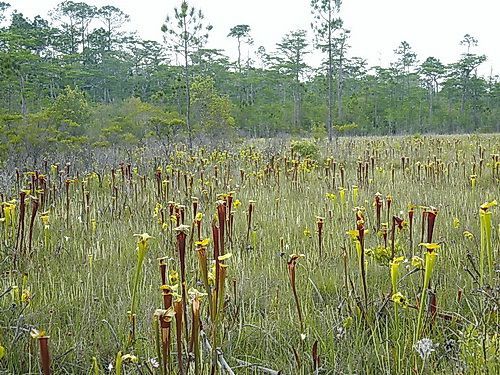
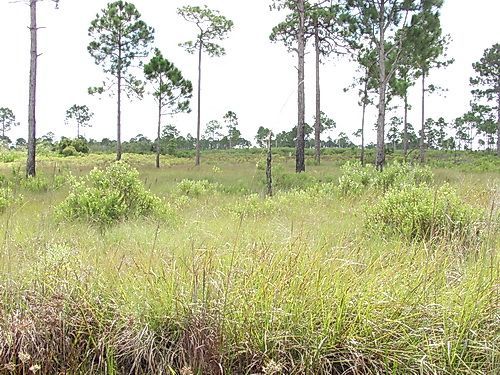
Wet prairies usually occur on acidic, nutrient-poor, saturated soils. Flooding, if it occurs, is typically brief. A calcareous variant is found in parts of central Florida. Most wet prairies are associated with flat topography, often forming in shallow depressional areas. These wetlands are maintained by frequent fire; without it, they may be overtaken by shrubs.
The edges of wet prairies are generally dominated by wiregrass ( Aristida stricta ). Other common species include foxtail clubmoss ( Lycopodiella alopecuroides ), cutover muhly ( Muhlenbergia capillaris ), and savannah meadowbeauty ( Rhexia alifanus ). In wetter portions, wiregrass may persist or give way to sedges such as plumed beaksedge ( Rhynchospora plumosa ), featherbristle beaksedge ( Rhynchospora oligantha ), Baldwin’s nutrush ( Scleria baldwinii ), slenderfruit nutrush ( Scleria georgiana ), or grasses such as longleaf threeawn ( Aristida palustris ). Wet prairies are especially known for their carnivorous plants, including pitcher plants ( Sarracenia spp. ), sundews ( Drosera spp. ), butterworts ( Pinguicula spp. ), and bladderworts ( Utricularia spp. ) (FNAI, 2010).
Wet prairies are noted for high species diversity, particularly in the Panhandle, where many rare species occur.
Example Locations
- Kissimmee Prairie State Park
- Audubon Corkscrew Swamp Sanctuary (in a broad band around the main swamp)
Variants
- Pitcherplant Prairies (Panhandle): Found in Apalachicola National Forest, Tate’s Hell State Forest, and Garcon Point.
- Cutthroat Seeps (Lake Wales Ridge): Found at the Archbold Biological Station and nearby areas. These occur in shallow depressions or on slopes. They are highly fire-dependent, as cutthroat grass (Panicum abscissum) requires fire for successful germination.
- Calcareous Wet Prairies (South Florida): Found in Big Cypress National Preserve and Everglades National Park.
References:
Clewell, A.F. 1986. Natural setting and vegetation of the Florida Panhandle - An account of the environments and plant communities of northern Florida west of the Suwannee River. Report No. COESAM/PDEI-86/001. United States Army Corps of Engineers, Mobile District, Alabama.
Florida Department of Environmental Protection. 1992. Soil and Water Relationships of Florida's Ecological Communities http://www.dep.state.fl.us/water/wetlands/delineation/docs/soil-and-water.pdf
Duever, Linda. 1984 (February). Florida's Natural Communities: Seepage Communities. The Palmetto 4, #1:1-2, 10-11. http://fnps.org/assets/pdf/palmetto/v04i1p1duever.pdf
Duever, Linda. 1987 (Summer-Fall). Florida's Natural Communities: Wet Prairies. The Palmetto 7, #2:6-7. http://fnps.org/assets/pdf/palmetto/v07i2p6duever.pdf
Florida Natural Areas Inventory (FNAI). 2010. Guide to the natural communities of Florida: 2010 edition. Florida Natural Areas Inventory, Tallahassee, FL. http://fnai.org/naturalcommguide.cfm.
Knight, G. R., J. B. Oetting, and L. Cross. 2011. Atlas of Florida's Natural Heritage - Biodiversity, Landscapes, Stewardship and Opportunities: Institute of Science and Public Affairs, Florida State University, Tallahassee, FL.
Myers, R.L. and J.J. Ewel (eds.). 1990. Ecosystems of Florida University of Central Florida Press: Orlando.
Noss, R. F. 2013. Forgotten Grasslands of the South - Natural History and Conservation. Island Press, Washington.
Noss, R. F. 2018. Fire Ecology of Florida and the Southeastern Coastal Plain. University Press of Florida, Gainesville.
USDA Soil Conservation Service. 1986. 26 Ecological Communities of Florida. http://ufdc.ufl.edu/UF00000110/00001
Whitney, E.N., D. B. Means, A. Rudloe. 2004. Priceless Florida: Natural Ecosystems and Native Species. Pineapple Press.
Click to learn about different Florida plant communities or scroll through the page to see all the wonderful unique diversity to be explored.
