


Florida's Native Plant Communities
Xeric Hammock
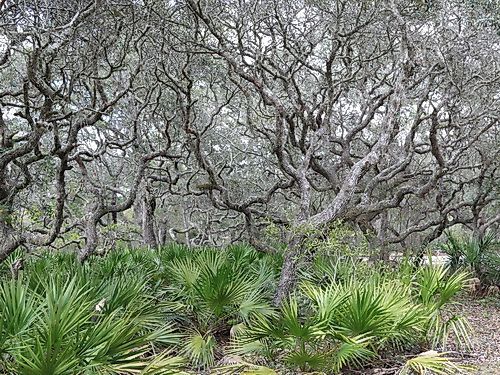
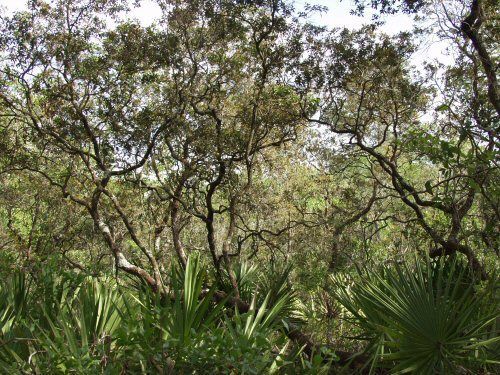
Photographs belong to the photographers who allow use for FNPS purposes only.
Information
Community Variants:
N/A
Description:
Xeric hammock is a community type that typically develops from sandhill, scrub, or scrubby flatwoods through either fire exclusion or the use of an altered fire regime, such as winter burns. The absence of natural fire—or replacement with winter burning—allows species usually associated with more mesic sites to invade and gradually dominate. Historically, winter burning was often coupled with cattle grazing; because cattle tend to avoid the tough leaves of saw palmetto ( Serenoa repens ), this practice frequently led to dense stands of saw palmetto beneath the oaks.
A typical xeric hammock features an overstory dominated by sand live oak ( Quercus geminata ), often mixed with sand post oak ( Quercus margaretta ), turkey oak ( Quercus laevis ), pignut hickory ( Carya glabra ), blackjack oak ( Quercus marilandica ), and/or laurel oak ( Quercus laurifolia ). The understory is usually sparse but may include sparkleberry ( Vaccinium arboreum ) and rusty lyonia ( Lyonia ferruginea ).
The ground layer varies, sometimes dominated by dense saw palmetto, while in other cases remaining largely bare. Remnants of the predecessor community may persist, with species such as gopher apple ( Licania michauxii ) surviving in openings.
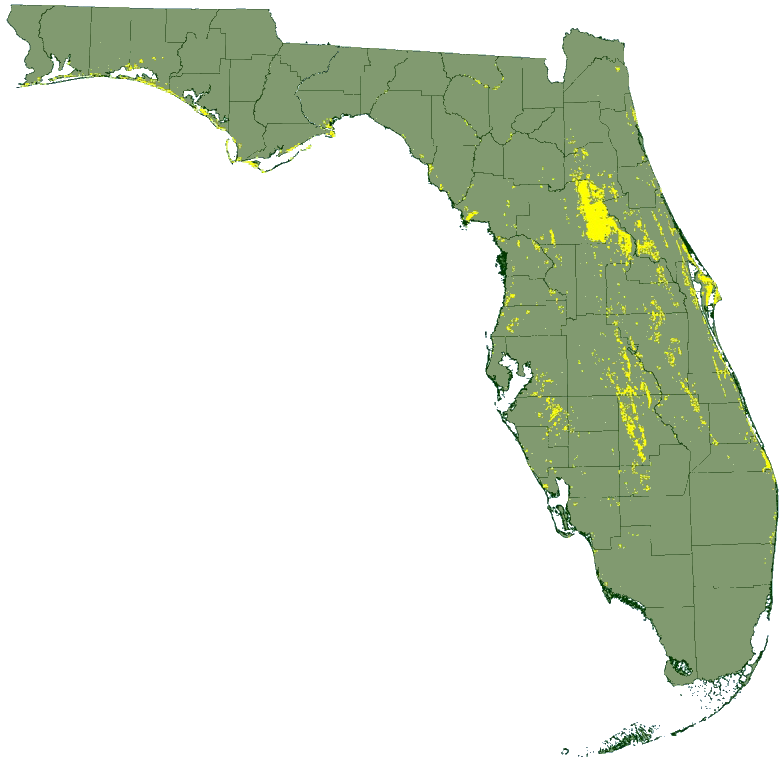
Scrubs (yellow). Mapping modified from a scrub map by the Archbold Biological Station, 2011.
References:
Duever, L. (1983, August). Florida’s natural communities: Inland sand ridges. The Palmetto, 3(3), 1–3, 10. http://fnps.org/assets/pdf/palmetto/duever_linda_conway_natural_communities_of_floridas_inland_sand_ridges_vol_3_no_3_aug_1983.pdf
Florida Department of Environmental Protection. (1992). Soil and water relationships of Florida’s ecological communities. http://www.dep.state.fl.us/water/wetlands/delineation/docs/soil-and-water.pdf
Florida Natural Areas Inventory. (2010). Guide to the natural communities of Florida: 2010 edition. Florida Natural Areas Inventory. http://fnai.org/naturalcommguide.cfm
Guerin, D. N. (1993). Oak dome clonal structure and fire ecology in a Florida longleaf pine dominated community. Bulletin of the Torrey Botanical Club, 120(2), 107–114. https://doi.org/10.2307/2996984
Laessle, A. M. (1958). The origin and successional relationship of sandhill vegetation and sand-pine scrub. Ecological Monographs, 28(4), 361–387. https://doi.org/10.2307/1942258
Myers, R. L., & Ewel, J. J. (Eds.). (1990). Ecosystems of Florida. University of Central Florida Press.
Peet, R. K., & Allard, D. J. (1993). Longleaf pine vegetation of the southern Atlantic and eastern Gulf Coast regions: A preliminary classification. In S. M. Hermann (Ed.), The longleaf pine ecosystem: Ecology, restoration and management (pp. 45–82). Tall Timbers Research Station.
U.S. Department of Agriculture, Soil Conservation Service. (1986). 26 ecological communities of Florida. http://ufdc.ufl.edu/UF00000110/00001
Whitney, E. N., Means, D. B., & Rudloe, A. (2004). Priceless Florida: Natural ecosystems and native species. Pineapple Press.
Click to learn about different Florida plant communities or scroll through the page to see all the wonderful unique diversity to be explored.
