

Florida's Native Plant Communities
Hydric Hammock
Photographs belong to the photographers who allow use for FNPS purposes only.
Information
Community Variants:
N/A
Description:
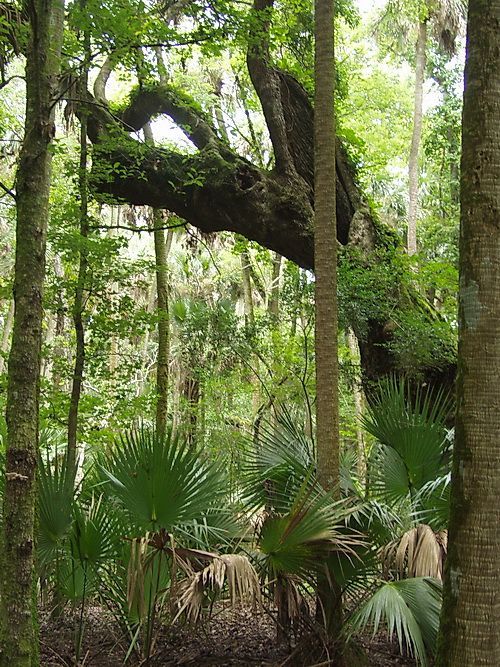
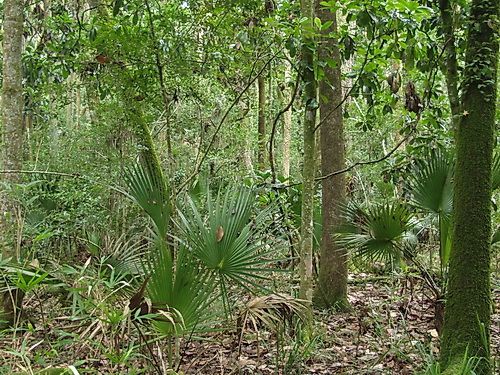
Hydric hammocks are found in central and northern Florida, typically on low, flat, poorly drained sites maintained by rainfall. While flooding is usually brief, soils often remain moist for extended periods. In some areas, limestone lies near the surface, and hydric conditions may also be influenced by river flooding, seepage, or spring discharge. Soils are variable—ranging from somewhat acidic to slightly alkaline with little organic matter—but alkaline materials are always present in the substrate. These conditions favor calcium-loving species such as red cedar ( Juniperus virginiana ) and rattan vine ( Berchemia scandens ). Fire is rare to occasional, depending on surrounding community fire frequency and hammock size (FNAI, 2010).
Vegetation
Characteristic canopy and subcanopy species include water oak ( Quercus nigra ), cabbage palm ( Sabal palmetto ), red cedar ( Juniperus virginiana ), red maple ( Acer rubrum ), several bay species ( Persea spp. ), hackberry ( Celtis laevigata ), American hornbeam ( Carpinus caroliniana ), blackgum ( Nyssa sylvatica ), needle palm ( Rhapidophyllum hystrix ), and other hardwoods.
Notable rare species associated with hydric hammocks include:
- Auricled spleenwort ( Asplenium erosum )
- Chapman’s sedge ( Carex chapmanii )
- Hay-scented fern ( Dennstaedtia bipinnata )
- Florida hasteola ( Hasteola robertiorum )
- Star anise (I llicium parviflorum )
- Hand fern ( Ophioglossum palmatum )
- Plume polypody ( Pecluma plumula )
- Terrestrial peperomia ( Peperomia humilis )
- Pinewoods dainties ( Phyllanthus liebmannianus ssp. platylepis )
- Pinkroot ( Spigelia loganioides )
Good examples of hydric hammock occur at:
- Bulow Creek State Park
- Waccasassa Bay Preserve State Park
- Chassahowitzka Wildlife Management Area
- Lower Hillsborough River Flood Detention Area
- St. Marks National Wildlife Refuge
- Triple N Ranch Wildlife Management Area
- Richloam Unit, Withlacoochee State Forest
References:
Clewell, A. F. (1986). Natural setting and vegetation of the Florida Panhandle: An account of the environments and plant communities of northern Florida west of the Suwannee River (Report No. COESAM/PDEI-86/001). U.S. Army Corps of Engineers, Mobile District.
Florida Department of Environmental Protection. (1992). Soil and water relationships of Florida's ecological communities. http://www.dep.state.fl.us/water/wetlands/delineation/docs/soil-and-water.pdf
Florida Natural Areas Inventory. (2010). Guide to the natural communities of Florida: 2010 edition. Florida Natural Areas Inventory. http://fnai.org/naturalcommguide.cfm
Knight, G. R., Oetting, J. B., & Cross, L. (2011). Atlas of Florida's natural heritage: Biodiversity, landscapes, stewardship and opportunities. Institute of Science and Public Affairs, Florida State University.
Myers, R. L., & Ewel, J. J. (Eds.). (1990). Ecosystems of Florida. University of Central Florida Press.
U.S. Department of Agriculture, Soil Conservation Service. (1986). 26 ecological communities of Florida. http://ufdc.ufl.edu/UF00000110/00001
Vince, S. W., Humphrey, S. R., & Simons, R. W. (1989). The ecology of hydric hammocks: A community profile (Biological Report 85[7.26]). U.S. Fish and Wildlife Service. https://pubs.usgs.gov/unnumbered/70110600/report.pdf
Whitney, E. N., Means, D. B., & Rudloe, A. (2004). Priceless Florida: Natural ecosystems and native species. Pineapple Press.
Click to learn about different Florida plant communities or scroll through the page to see all the wonderful unique diversity to be explored.
