


Florida's Native Plant Communities
Slough
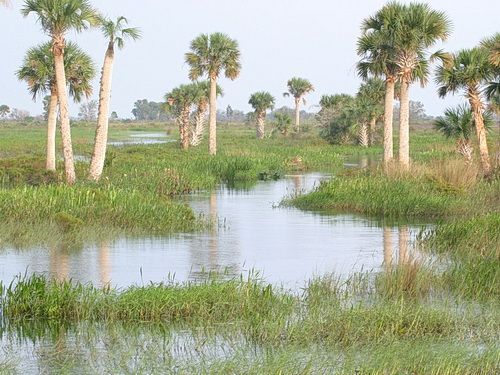
Photographs belong to the photographers who allow use for FNPS purposes only.
Information
Community Variants:
Slough Marsh, Everglades Slough
Description:
Sloughs are shallow, non-forested wetlands with slow-moving water. Fire is an important factor in maintaining these systems. Many sloughs may be anthropogenic in origin, as they often occur in open settings where the landscape was historically forested.
Generic sloughs fitting this description can be found at Kissimmee Prairie State Park and in other areas where the uplands were historically dry prairie.
Slough Marsh (Everglades Slough)
The primary sloughs of South Florida are known as Everglades sloughs, or slough marshes. They occur in areas of marl overlying limestone. When the Everglades was described as the “River of Grass,” it was these sloughs that were being referenced. Water moves very slowly through them, ranging from less than 1 to over 4 cm per second at Shark Valley Slough, depending on weather conditions (Riscassi & Schaffranek, 2002).
Vegetation
Typical vegetation includes sawgrass ( Cladium jamaicense ), spikerush ( Eleocharis spp. ), and various grasses. Cattails ( Typha spp. ) frequently invade disturbed areas. Dwarfed pond cypress ( Taxodium ascendens ) may also be present. For detailed species accounts, see FNAI (2010).
Example Locations
- Everglades National Park – Shark Valley Slough
- Everglades National Park – Anhinga Trail
References:
Duever, M. J., Carlson, J. E., Meeder, J. F., Duever, L. C., Gunderson, L. H., Riopelle, L. A., Alexander, T. R., Myers, R. L., & Spangler, D. P. (1986). The Big Cypress National Preserve (Research Report 8). National Audubon Society.
Florida Department of Environmental Protection. (1992). Soil and water relationships of Florida's ecological communities. http://www.dep.state.fl.us/water/wetlands/delineation/docs/soil-and-water.pdf
Florida Natural Areas Inventory. (2010). Guide to the natural communities of Florida: 2010 edition. Florida Natural Areas Inventory. http://fnai.org/naturalcommguide.cfm
Myers, R. L., & Ewel, J. J. (Eds.). (1990). Ecosystems of Florida. University of Central Florida Press.
National Research Council. (2003). Does water flow influence Everglades landscape patterns? The National Academies Press. https://doi.org/10.17226/10533
Riscassi, A. L., & Schaffranek, R. W. (2002). Flow velocity, water temperature, and conductivity in Shark River Slough, Everglades National Park, Florida: July 1999–August 2002 (Open-File Report 02-159). U.S. Geological Survey.
U.S. Department of Agriculture, Soil Conservation Service. (1986). 26 ecological communities of Florida. http://ufdc.ufl.edu/UF00000110/00001
Whitney, E. N., Means, D. B., & Rudloe, A. (2004). Priceless Florida: Natural ecosystems and native species. Pineapple Press.
Click to learn about different Florida plant communities or scroll through the page to see all the wonderful unique diversity to be explored.
