


Florida's Native Plant Communities
Coastal Strand
Photographs belong to the photographers who allow use for FNPS purposes only.
Information
Community Variants:
Stabilized Dunes, Coastal Thickets
Description:
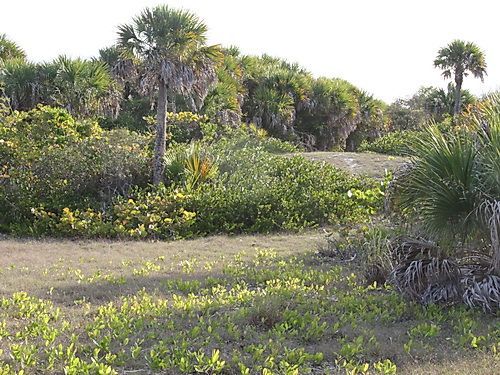
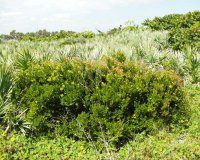
Coastal strands are densely vegetated habitats that develop on sandy or mixed sand–shell substrates along active coastlines, often on barrier islands. These systems are shaped by salt spray and high winds and are subject to rapid reconfiguration—or even destruction—during hurricanes and storm surges.
Vegetation
The community is typically dominated by dense thickets of xerophytic shrubs and small trees, including:
- Sea grape ( Coccoloba uvifera )
- Prickly-pear cactus ( Opuntia stricta )
- Poison ivy ( Toxicodendron radicans )
- Spanish bayonet ( Yucca aloifolia )
- Wax myrtle ( Morella cerifera )
- Sea myrtle ( Baccharis halimifolia )
- Coral bean ( Erythrina herbacea )
- Saw palmetto ( Serenoa repens )
- Other salt- and wind-tolerant shrubs
References:
Duever, L. C. (1986). Florida’s natural communities: Overwash plains and coastal berms. The Palmetto, 6(1), 10–11. http://fnps.org/assets/pdf/palmetto/v06i1p10duever.pdf
Duever, L. (1983, November). Florida’s natural communities: Coastal dunes. The Palmetto, 3(4), 4–5. http://fnps.org/assets/pdf/palmetto/v03i4p4duever.pdf
Duever, L. (1985–1986, Winter). Florida’s natural communities: Coastal mounds. The Palmetto, 5(4), 15. http://fnps.org/assets/pdf/palmetto/v05i4p15duever.pdf
Florida Department of Environmental Protection. (1992). Soil and water relationships of Florida's ecological communities. http://www.dep.state.fl.us/water/wetlands/delineation/docs/soil-and-water.pdf
Florida Natural Areas Inventory. (2010). Guide to the natural communities of Florida: 2010 edition. Florida Natural Areas Inventory. http://fnai.org/naturalcommguide.cfm
Gann, G. D., Bradley, K. A., & Woodmansee, S. W. (2009). Floristic inventory of South Florida database. Institute for Regional Conservation. http://regionalconservation.org/ircs/database/database.asp
Knight, G. R., Oetting, J. B., & Cross, L. (2011). Atlas of Florida's natural heritage: Biodiversity, landscapes, stewardship and opportunities. Institute of Science and Public Affairs, Florida State University.
Myers, R. L., & Ewel, J. J. (Eds.). (1990). Ecosystems of Florida. University of Central Florida Press.
U.S. Department of Agriculture, Soil Conservation Service. (198?). 26 ecological communities of Florida. http://ufdc.ufl.edu/UF00000110/00001
Whitney, E. N., Means, D. B., & Rudloe, A. (2004). Priceless Florida: Natural ecosystems and native species. Pineapple Press.
Click to learn about different Florida plant communities or scroll through the page to see all the wonderful unique diversity to be explored.
