


Florida's Native Plant Communities
High Pine
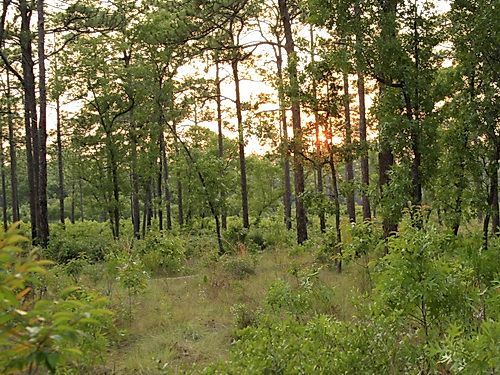
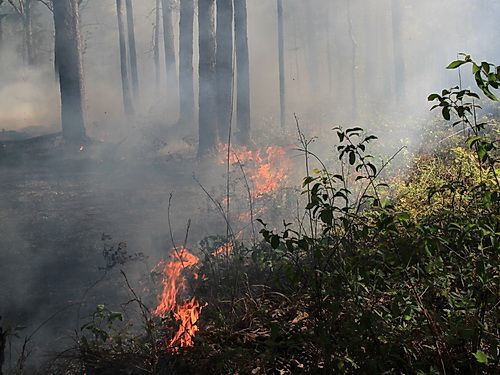
Photographs belong to the photographers who allow use for FNPS purposes only.
Information
Community Variants:
Sandhill, Clayhill, Longleaf Pine Savanna
Description:
High Pine is a temperate-to-peninsular ecosystem occurring on hilltops and gentle slopes. It is characterized by excessively drained soils: if sandy, the community is known as sandhill; if clayey, as clayhill.
High Pine is a pyrophytic plant community with a natural fire return interval of 2–5 years. It typically features widely spaced longleaf pine ( Pinus palustris ) and/or turkey oak ( Quercus laevis ), with a wiregrass ( Aristida stricta ) understory. The absence of pines usually reflects past land use, particularly logging, and often results in sandhill dominated by xeric oaks—especially turkey oak. Fire suppression can shift the community toward scrubby vegetation, creating a so-called “scrubby sandhill.”
Florida’s High Pine is notable for its high level of plant endemism (species found only in Florida). While relatively few rare species are restricted exclusively to this community, three noteworthy endemics depend on it: Warea amplexifolia and pigeon wing ( Clitoria fragrans ), both found in the sandhills of the central Florida ridges, and zigzag silkgrass ( Pityopsis flexuosa ), found in the eastern Panhandle.
Historically, longleaf pine dominated the coastal plain of the southeastern United States. Today, only 2–3% of the original range remains, and most of that is highly disturbed. Florida contains the majority of the best remaining longleaf pine forests and nearly all of the old-growth stands. Within Florida, longleaf pine ecosystems include High Pine as well as relatively dry Pine Flatwoods. The largest remaining example of old-growth High Pine occurs in Blackwater River State Forest and on Eglin Air Force Base. High Pine, in varying condition, can be found throughout North Florida and extends southward into peninsular Florida, as far as Sarasota and Highlands counties.
Excellent places to explore high-quality High Pine include:
- Blackwater River State Forest
- Eglin Air Force Base (permit required)
- Gold Head Branch State Park
- Ocala National Forest
- Wekiva Springs State Park
- Citrus Tract of the Withlacoochee State Forest
- Leon Sinks area of Apalachicola National Forest
References:
Clewell, A. F. (1986). Natural setting and vegetation of the Florida Panhandle: An account of the environments and plant communities of northern Florida west of the Suwannee River (Report No. COESAM/PDEI-86/001). U.S. Army Corps of Engineers, Mobile District.
Florida Department of Environmental Protection. (1992). Soil and water relationships of Florida's ecological communities. http://www.dep.state.fl.us/water/wetlands/delineation/docs/soil-and-water.pdf
Florida Natural Areas Inventory. (2010). Guide to the natural communities of Florida: 2010 edition. Florida Natural Areas Inventory. http://fnai.org/naturalcommguide.cfm
Laessle, A. M. (1958). The origin and successional relationship of sandhill vegetation and sand-pine scrub. Ecological Monographs, 28(4), 361–387. https://doi.org/10.2307/1942258
Myers, R. L., & Ewel, J. J. (Eds.). (1990). Ecosystems of Florida. University of Central Florida Press.
Noss, R. F. (2013). Forgotten grasslands of the South: Natural history and conservation. Island Press.
Peet, R. K., & Allard, D. J. (1993). Longleaf pine vegetation of the southern Atlantic and eastern Gulf Coast regions: A preliminary classification. In S. M. Hermann (Ed.), The longleaf pine ecosystem: Ecology, restoration and management (pp. 45–82). Tall Timbers Research Station.
U.S. Department of Agriculture, Soil Conservation Service. (1986). 26 ecological communities of Florida. http://ufdc.ufl.edu/UF00000110/00001
Whitney, E. N., Means, D. B., & Rudloe, A. (2004). Priceless Florida: Natural ecosystems and native species. Pineapple Press.
Click to learn about different Florida plant communities or scroll through the page to see all the wonderful unique diversity to be explored.
